School Backpack Artwork Proofing: 5 Errors That Cost a Container
Artwork approval is the last cheap checkpoint in a school backpack order. Once the print run starts, a wrong logo colour or a misspelled line is charged against every unit in the container. The five errors below are the ones that most often survive a quick proof sign-off and then surface on 3,000 bags. Check each one on a sewn sample, not just on a screen.
1. Logo colour that drifts from the reference
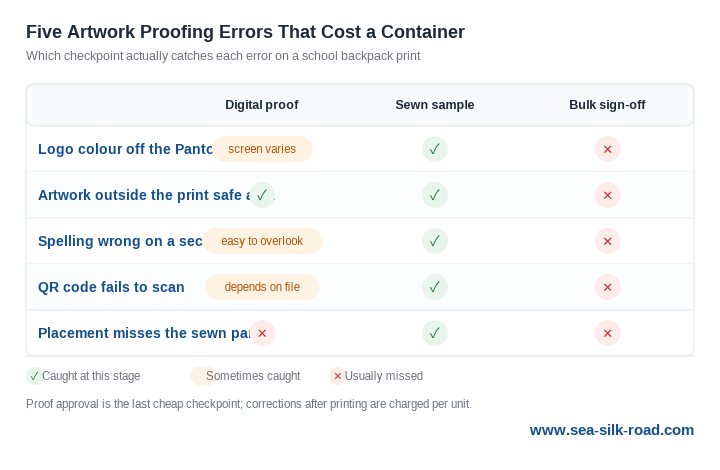
A logo that looks right on a backlit screen often prints a shade lighter on canvas. Screen proofing is useful for layout, but it is not a colour standard. Ask the supplier to print the logo on the actual bag fabric and hold it against the agreed Pantone reference under normal light. Record the approved sample with a date and a signature so that a later batch can be compared against something physical. If the bag uses a coated finish, confirm the colour on that finish, because ink sits differently on coated and uncoated canvas.
2. Artwork that falls outside the safe area
Every sewn panel has a seam allowance and a curve where print will not land cleanly. Artwork placed too close to a seam gets folded into the stitch line or clipped by the panel edge. Mark the safe area on the proof and keep all text and logo elements inside it. On a school backpack the front pocket is the usual print zone, but its usable rectangle is smaller than the pocket itself. Ask for the exact printable dimensions rather than assuming the whole panel is available.
3. Spelling and copy errors on secondary panels
Buyers proof the front logo carefully and then miss a typo on the side label, the care tag or a woven strap. Walk the proof panel by panel and read every word aloud, including small print. If the bag carries a school name or a registration line, assign one person to check that string against the source document character by character. This is the cheapest error to fix at proof stage and the most embarrassing to ship.
4. QR codes that fail to scan
A QR code that links to the school site or a welcome page is only useful if it scans at a normal distance. Proof the code on the sewn sample, not in the design file, and scan it with a phone at arm's length. Contrast matters: a light code printed on a light canvas may fail even though the file is correct. Keep a clear margin around the code and avoid placing it over a seam or a pocket fold. If the campaign depends on the scan rate, test more than one phone model.
5. Placement that misses the sewn panel
Digital proofs show artwork on a flat outline of the bag. The sewn bag has depth, curves and pockets that shift where a print actually sits. A logo centred on a flat template can end up high on one side of a gusset. Approve placement on a real sample and mark the position with pins or a template before signing. This is the error a bulk sign-off almost never catches, which is why it belongs on the pre-production sample check.
How to run the proof check
Ask for two things at the proof stage: a digital layout for position and a physical sewn sample for colour, texture and scan tests. Give the supplier one consolidated list of corrections instead of drip-feeding changes, because each new proof round adds days. Set a clear approval rule with whoever signs internally, so that one person owns the final sample. When the sample is approved, keep it as the reference for the production batch and for any reorder six months later.
One more point is worth building into the schedule: proof rounds take time, and rushing them is what turns a small correction into a container-level problem. A typical custom run has a digital layout, a sewn pre-production sample and a final colour sign-off. Each round has a cost in days, so send a complete artwork package the first time, with vector files, colour references and the exact copy for every panel. Ask the supplier to quote how many proof rounds are included and what each extra round costs. When the production batch arrives, compare it against the approved sample before the whole order is packed; catching a drift at that point is still far cheaper than discovering it after the cartons have shipped. Good proofing is not about finding fault with the supplier, it is about giving both sides one physical reference that everyone agrees on.
Planning a school backpack run? Send us your artwork and the panel you want it on, and we will confirm the safe area, the print method and a proof schedule. Browse our school backpack range to see base bodies suitable for custom artwork, then request a free sample and quote with your quantity.
Planning a promotional gift order?
Send your spec and target quantity for a quote and a digital proof.
Get a free quote