Briefcase Price Breaks: 300 vs 1,000 vs 3,000 Units
A briefcase quoted at 300 units and the same briefcase at 3,000 units can differ by a fifth or more per piece, even though the leather, hardware and stitching are identical. What changes is not the material but how a set of fixed costs is spread across the run. Understanding those steps lets you plan the order size around a real cost curve instead of assuming the supplier simply lowered the price. This guide walks through the cost lines that move with quantity, shows where a 300 / 1,000 / 3,000 quote typically breaks, and lists what to lock before committing to the larger tier.
1. What a Price Break Really Is
A price break is the per-unit result of spreading setup costs over more pieces. Cutting dies, a first-article sample, a print plate for the logo, a dedicated inspection lot and a packing line setup all cost roughly the same whether the run is short or long. At 300 units each of those charges is still a noticeable slice of the unit price. At 3,000 units the same charge is divided ten ways, so it nearly disappears. The material and labour portion of the price barely moves. When a supplier shows a lower number for a bigger run, ask which fixed line was reallocated rather than assuming the leather got cheaper.
2. The Five Fixed Costs Behind the Step
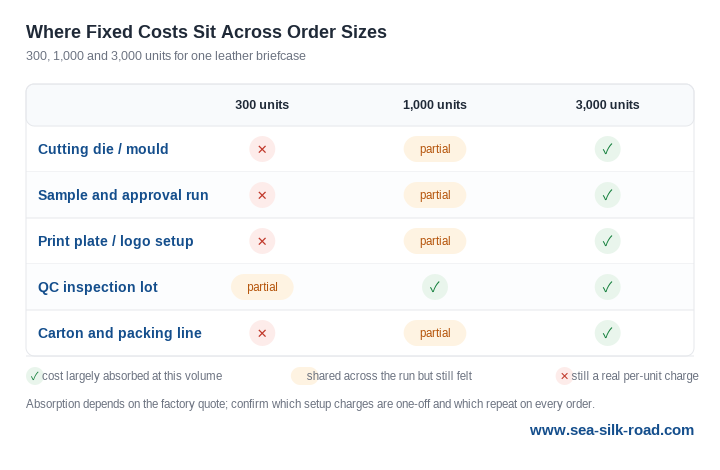
Start with the cutting die or mould. A briefcase pattern needs a die for the panels; that is a one-off tool charge that repeats only if the pattern changes. Next is the sample and approval run, including the first article the buyer signs off. Third is the logo setup, whether a deboss plate, a foil die or a print screen. Fourth is the inspection lot: a separate QC pass has a setup cost regardless of how many pieces it covers. Fifth is packing line setup, including carton dimensions and any custom insert. These are the lines that produce the step effect when volume doubles.
The figure below maps which of these charges is still material at each tier. None of the amounts are fixed industry numbers; your supplier quote is the only authoritative source. The value of the map is that it tells you which questions to ask: if a charge is one-off, it should fall sharply per unit as volume rises; if it is a per-piece cost, it should not.
3. Reading a 300 / 1,000 / 3,000 Quote
Ask for the quote as three columns with the same specification in each. Keep leather grade, hardware, lining, stitch count and packing identical so that only quantity changes. Then subtract the material and labour estimate from each column; what remains is the fixed-cost allocation. If the drop from 300 to 1,000 is large but the drop from 1,000 to 3,000 is small, most of the setup is already covered at 1,000 and the extra volume buys little. If the second drop is still steep, the die or plate charge is significant and the largest tier may be worth the cash.
Watch for quotes that change the spec between tiers - a thicker lining at 3,000 units or an upgraded zipper - because that hides a material cost inside the price break. Ask the supplier to mark any specification change in a separate line. A genuine quantity discount is transparent about which costs moved.
4. Where the Savings Stop
Price breaks flatten once setup is fully absorbed. Beyond that point the only savings come from material buying and line efficiency, which are smaller and depend on the factory's own volume. A 3,000-unit order also ties up cash and storage, and it commits you to a design before the market has tested it. If the briefcase is a new style, the sensible sequence is a 300-unit pilot to validate the spec, then a 1,000-unit repeat once returns and feedback are known. The pilot costs more per piece but it is the cheapest way to avoid paying for a full run of a design that needs changes.
5. What to Lock Before the Bigger Tier
Before moving from 300 to 3,000 units, lock the signed sample, the exact bill of materials, the logo artwork and the packing method in one document attached to the PO. Confirm in writing that the die and plate charges are one-off for this pattern and will not reappear on the repeat order. Agree the inspection standard and the acceptable defect rate so that the larger lot is judged the same way as the pilot. Once those items are fixed, the price break becomes a predictable number rather than a negotiation. Send us your briefcase specification and the three target quantities, and we will return a quote that shows the fixed-cost lines separately.
Planning a promotional gift order?
Send your spec and target quantity for a quote and a digital proof.
Get a free quote