Handbag Payment Terms: 30/70, LC and Trade Assurance
Three payment structures cover almost every handbag order placed from overseas: a 30 percent deposit with the balance before shipment, a letter of credit at sight, and a platform escrow product such as Trade Assurance. They are not three prices for the same protection. Each moves a different risk to a different party, and each costs money somewhere that does not show up in the unit price: bank charges, cash tied up for weeks, or a deposit already spent on material before you have seen a single bag.
What Each Term Actually Commits You To
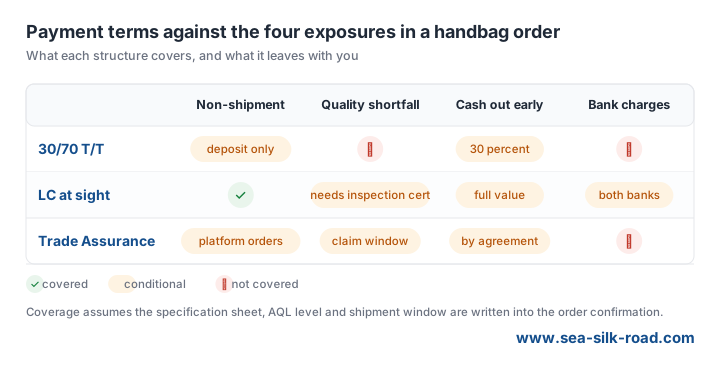
A 30/70 telegraphic transfer is the default in sewn goods because the factory needs cash before it buys fabric, hardware and lining. The 30 percent usually covers material and cutting; the 70 percent is released when the goods are ready, and the exact moment it is released is the clause worth arguing about. A letter of credit replaces trust with documents: the bank pays when the presented papers match the credit exactly, regardless of what the bags look like. Trade Assurance is an order-level mediation service tied to a platform account, and it only reaches as far as the order contract you wrote inside that platform.
All three fail the same way when the specification is loose. If the order says PU leather without naming the backing, thickness or colour reference, no payment term will recover a shipment that matches the words and not the expectation.
30/70 T/T: Where the Risk Sits and How to Make the 30 Percent Work
The deposit is the part that carries real exposure, so treat it as a purchase of material rather than a gesture of good faith. Four things make it safer without changing the percentage.
- Tie the balance to an event, not a date. Balance against a copy of the bill of lading means the goods exist and have shipped; balance before shipment means you pay for something still on the factory floor. Both are common, but only the second needs an inspection report as a condition.
- Name the inspection before the balance. A pre-shipment check at AQL 2.5 on major defects, with the report as a release condition, is the cheapest insurance in the whole deal. Without it, the 70 percent is paid against photographs.
- Split the deposit if the order is large. A first deposit for material and a second when the sample is approved keeps the factory moving without putting the whole 30 percent down before you have held a bag.
- Say what happens to the deposit if the sample fails. The silent assumption is that it is refundable; the written reality is often that cutting has started. Write the refund rule into the order confirmation.

LC at Sight: What It Costs and What It Protects
A letter of credit is worth its cost when the order is large enough that a total loss would hurt, when the supplier is new, or when the destination country requires it for foreign exchange. It is not free: the issuing bank charges a fee, the advising bank charges another, and every discrepancy you have to fix costs an amendment. The credit also has to be opened weeks before shipment, and it expires on a date, not on your convenience.
The work sits in the wording. The credit must accept the documents the factory can actually produce: commercial invoice, packing list, bill of lading, certificate of origin, and any inspection certificate you want as a condition of payment. Two practical rules cut most of the pain. First, keep the document list short and identical to what the factory has issued before. Second, put the tolerances in the credit rather than in an email, because a shipment quantity or a description that differs by a word from the credit is a discrepancy, and discrepancies are where the bank stops paying.
Trade Assurance and Platform Escrow: Where It Helps and Where It Stops
An escrow-style product is a mediation layer, not an inspection service. It is useful for the case it was built for: an order that does not arrive, or arrives in a quantity or specification that clearly contradicts the order page. It is weak exactly where sewn goods disputes usually start, which is a judgement call about stitching, colour or hand feel that no platform can adjudicate from photographs.
Two habits make it work. Put the specification, the AQL level and the packaging in the order text itself rather than in the chat, because the order text is what the claim is measured against. And check the claim window before the goods ship: a dispute filed after the window closes is a support ticket, not a claim.
Matching the Term to the Order
The useful question is not which term is safest but which risk you are actually carrying. A repeat order with a supplier who has shipped three times on schedule needs speed, not paperwork. A first order with a new factory and a custom colour needs documents and an inspection. A small trial order behind a platform account needs the specification written tightly, because the order text is what the platform recognises.
Clauses That Decide Whether the Term Protects You
Payment terms are four lines in a longer document, and the surrounding clauses decide how much they are worth. Five are worth insisting on in every handbag order: an agreed specification sheet with material, hardware and colour references; an AQL level and the inspection timing; a shipment window with a stated consequence for late delivery; a rule for the deposit if the sample is rejected; and a statement of who pays which bank charges. On the last point, the usual split is that the buyer pays the issuing bank and the seller pays the advising bank, and it should be written rather than assumed.
Currency belongs in the same paragraph. If the order is priced in one currency and settled in another, the exchange difference lands on whoever the contract names, and silence puts it on the buyer.
Send the order quantity, the material and the destination port, and we will quote the three payment routes side by side with the inspection and document list each one needs. Browse the handbags range first, then tell us which construction you are pricing so the schedule matches the build.
Planning a promotional gift order?
Send your spec and target quantity for a quote and a digital proof.
Get a free quote


