Handbag MOQ Explained: 4 Cost Lines That Set Your Minimum
A buyer asks for 200 handbags in three colours and gets a quote with a minimum of 500 pieces per colour. Nothing about the bag changed between the two emails. What changed is that the supplier stopped pricing a product and started pricing a production run — and a production run carries four fixed costs that do not care how many units you want. Once you can see those four lines, an MOQ stops being a rule you argue with and becomes a number you can move.
This guide is for buyers running a first or second order, where the quantity is small enough that the minimum decides whether the project happens at all. It uses a 500-piece leather handbag run as the example, but the structure holds for any sewn bag.

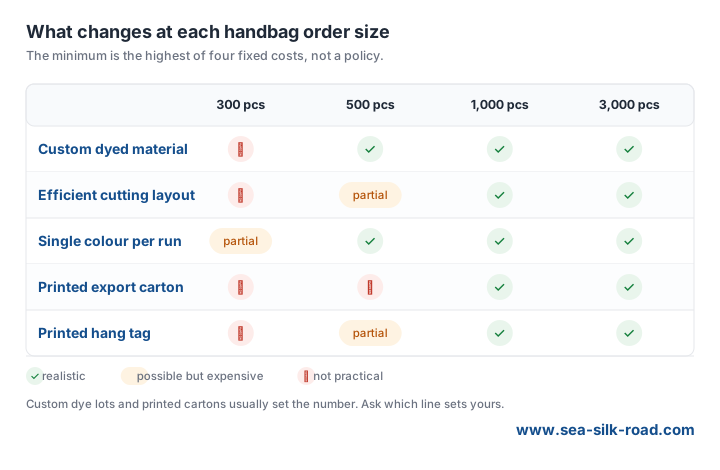
What the minimum is really protecting
A factory does not quote a minimum to protect its margin on your order. It quotes a minimum to avoid losing money on the steps that come before the sewing line. Four of them are fixed: the material order, the cutting layout, the line changeover, and the packing carton. Each has its own minimum quantity, and the highest of the four becomes the number you are told. When a supplier says "500 per colour," you are usually hearing about the dye lot, not the sewing.
Line one: material minimums
Leather, PU and coated fabric are sold by the roll, the hide or the weight, not by the bag. A tannery will not open a dye lot for 30 metres of a custom colour, and a PU mill typically quotes in 300 to 500 metre lots per shade. A handbag in the 25 to 35 cm size range consumes roughly 0.6 to 0.9 square metres of material once waste is counted, so 500 bags means 350 to 450 square metres — which is why 500 lands where it does for a custom shade. Standard black or brown, already in stock, can carry a much smaller order. If your minimum feels arbitrary, ask which material is driving it, then check whether a stock colour would remove it entirely.
Line two: the cutting table
Cutting is where small orders quietly get expensive. Panels are nested by hand or by a CAM table, and the layout is optimised for a run length. A 200-piece order may only fill two or three lays, which means the operator spends the same setup time spreading a shorter stack. The waste percentage rises too: with fewer pieces you cannot nest around a flaw in the hide as easily, so the effective material cost per bag climbs. Suppliers rarely show this line item, but it is the reason a 200-piece quote sometimes comes back higher per unit than a 500-piece one by more than the material difference alone.
Line three: line changeover
Every colour change on a sewing line costs a stop: re-threading to the matching thread, swapping the edge-paint pot, resetting the hardware bins, and running the first few pieces as a check. That stop is roughly the same whether the colour run is 50 pieces or 500. Three colours in one order therefore means three changes, and the cost per piece of those changes falls as the run grows. This is also the line that makes "same bag, different colour" behave differently from "same bag, same colour" — and why merging three 150-piece colours into one 450-piece colour often cuts the unit price more than negotiating the bag price itself.
Line four: packing and cartons
Dust bags, hang tags, polybags and printed cartons all have their own print minimums. A printed carton usually starts at 500 to 1,000 units, and a custom hang tag at 1,000. If you are ordering 300 bags, you will either pay a small-lot surcharge on packaging or accept a stock carton with a sticker. Neither is wrong, but the cost belongs in your comparison. Ask for the quote split with and without custom packaging; the gap is often larger than the gap on the bag itself.
The 300, 500 and 1,000 steps
| Quantity | What usually changes | Practical effect |
|---|---|---|
| 300 | Stock material, stock carton, single colour | Highest unit price; viable for a pilot or a market test |
| 500 | One custom dyed lot, printed hang tag | The first rung where custom colour is realistic |
| 1,000 | Custom printed carton, mixed hardware stock | Packaging minimums stop being a surcharge |
| 3,000 | Dedicated line time, better material price | Material discount starts to show in the quote |
When a small run is still the right call
If the bag is a new design, a small run is cheaper than a wrong large one. A 300-piece pilot that sells through in six weeks tells you more than any sample review, and the higher unit cost is the price of that information. What you should not do is pay a 300-piece price and then plan a 3,000-piece launch on the assumption that the design is proven. Keep the first run deliberately small, keep the packaging stock, and put the money into the second order once the sell-through is real.
What to ask before you accept the number
Four questions will usually get you to the real constraint: which material sets the minimum, whether a stock colour removes it, how many colours are being counted as separate runs, and whether packaging is included in the quantity. If the answer is "all four," ask for the quote both ways — one colour in a larger run, three colours in a smaller one — and compare the landed cost per bag rather than the unit price. Our handbag range is organised by material and construction, and a style like the PU leather handbag with a structured body or this top-handle PU handbag can usually be quoted in both directions within a day, which is faster than arguing about the number in the abstract.
Planning a promotional gift order?
Send your spec and target quantity for a quote and a digital proof.
Get a free quote


