Handbag Sourcing Calendar: 6 Lead Times to Plan Around
A handbag order runs on six dates, and four of the six are set by the buyer, not the factory. Buyers who count backwards from the day the goods must leave the port get a calendar that survives a re-proof. Buyers who count from the day the order was placed get a calendar that fails at the sample stage and blames the supplier for the rest of the season.
Build the Calendar From the Ship Date, Not the Order Date
Take the ship date on the booking confirmation and subtract in this order: inspection and booking cutoff, finishing, bulk production, sample approval, material and hardware booking. What is left is the date your purchase order has to be signed. On a typical leather or PU satchel with one custom logo plate, the sum of those blocks is about ten weeks, which is why a six-week request is not a negotiation about price but about which stage gets deleted.
Write the six dates into the purchase order as dates, not as durations. A duration slides with the order date and hides slippage; a fixed date exposes it on the same afternoon. Ask the supplier to countersign each date and to name what they need from you before it can be met: artwork, colour approval, deposit, or a signed sample.
Date One: Material and Lining Booking
PU and PVC arrive in dye lots, and a second lot of the same colour name is not the same colour. If the order is large enough to consume more than one roll of the face material or more than one roll of lining, the supplier has to book the quantity in a single lot or accept a visible shade break between cartons. That booking is the first date in the calendar, and it is also the reason a late quantity change is expensive: the mill sells in full rolls, and a top-up in the middle of production comes from a different lot.
Two checks belong on this date. Ask for the lot numbers of face material and lining to be recorded on the cutting sheet, so a shade complaint can be traced to a roll rather than to a batch. Ask whether the hardware is in stock or has to be ordered, because a bag with a custom buckle waits for the buckle, not for the leather.

Date Two: Custom Hardware and the Logo Plate
Anything that requires a new mould sits on its own clock. A debossed logo plate, a custom buckle or a shaped zip pull needs a tool cut before the first bag can be assembled, and that tool is the one item where money genuinely buys time: a second cavity or an overtime run shortens the tooling block rather than the sewing floor.
Decide on this date whether the logo is moulded, stamped or printed. A printed logo can be approved from a digital proof in a day; a moulded one needs a physical plate in hand before the sample is sewn, because the plate changes the thickness of the panel it sits on. Sign the artwork proof before the tool is cut, not after: a revision after cutting means a new tool, and the calendar restarts at this date.
Date Three: The Sample You Actually Sign
The sample date is where most calendars lose two weeks, and the loss is usually self-inflicted. A sample is not approved because it looks close; it is approved when the buyer has compared it against the spec sheet, weighed it, measured the strap drop, and photographed the interior. Send the checklist with the sample request so the sample room knows what will be measured.
Plan for one revision. Two rounds is normal on a new shape; three rounds means the spec was unclear at the start. Give the revision in one message with numbered points, because a second message that contradicts the first restarts the clock without anyone noticing.
Date Four: The Bulk Slot and the Holiday Squeeze
Production slots are finite in the weeks before Chinese New Year and around the National Day holiday, when factories close for a week or more and the week before closure is spent finishing rather than starting. If the ship date falls within four weeks after a major holiday, the bulk date moves earlier, not later: capacity is consumed by orders that were queued before the holiday, and a latecomer waits behind them.
Confirm the slot in writing with the expected start and end week. A supplier who says yes to a start date but not to an end date has given you half a commitment.
Dates Five and Six: Finishing, Inspection, Booking
Finishing covers the steps that cannot be parallelised with sewing: edge paint that needs to cure, thread trimming, hardware plating touch-up, and packing to the carton specification. Edge paint is a chemistry step, and no amount of money makes it dry faster without risking a smeared edge, which is why it belongs on the list of stages that do not compress.
The last date is the booking cutoff. A 40HQ container holds roughly 65 to 70 cubic metres, and handbags pack inefficiently because cartons cannot be crushed; a carton drop test and a stack test tell you whether the packing plan survives the container. Book the inspection before the goods are packed, not after, because a defect found in a sealed carton is a defect found at the destination.
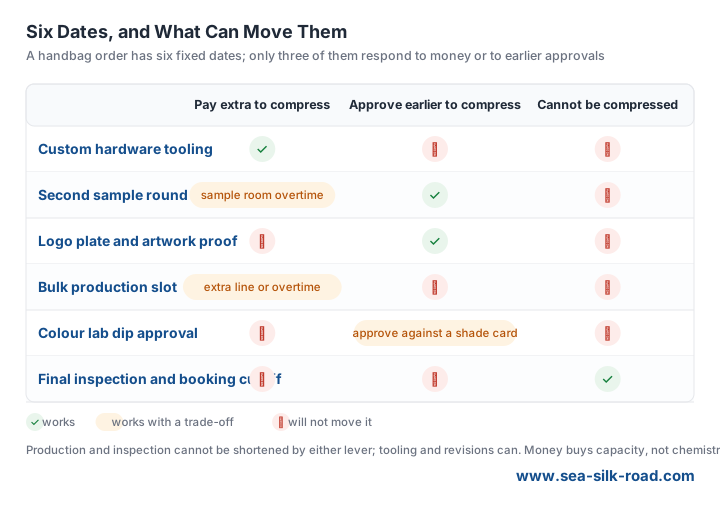
Put the buffer at the end, after inspection and before the vessel, not inside the production block. A buffer inside production gets consumed silently by the factory; a buffer in front of the vessel stays visible as the one week you can spend on a re-inspection or a re-pack. Two weeks of buffer on a ten-week calendar is a reasonable planning default for a first order with a new supplier, and it is the number to reduce only after that supplier has hit the dates once.
Send us the ship date, the bag style and the logo method, and we will lay the six dates against your calendar and tell you which one is already at risk.
Planning a promotional gift order?
Send your spec and target quantity for a quote and a digital proof.
Get a free quote


