Porcelain vs Stoneware for Promotional Gifts
Porcelain and stoneware can look identical in a catalogue photo and behave very differently by the time a pallet reaches a warehouse. Porcelain fires denser and absorbs less water; stoneware tolerates a knock better and usually costs less per piece. For a promotional order the decision usually turns on which failure you can afford: staining and crazing on one side, chips and freight damage on the other. This comparison walks through four criteria that decide most corporate gift programmes, with the checks to run before you lock a clay body.
1. Water Absorption and Staining
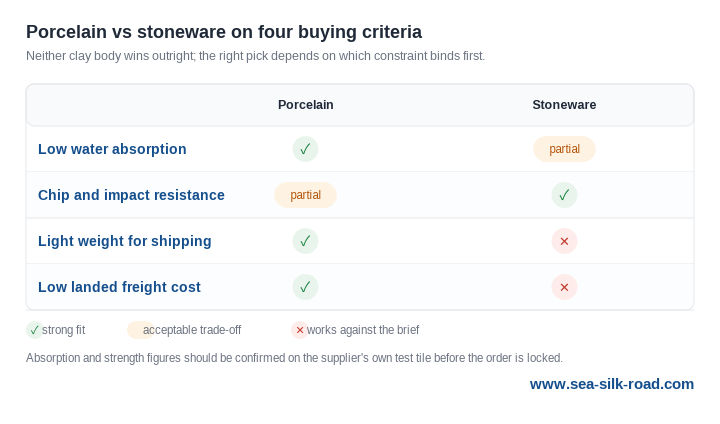
Ask the supplier for the water absorption figure of the actual body, measured on a test tile rather than quoted from a generic data sheet. Vitrified porcelain typically absorbs under 0.5 percent; stoneware is higher and varies widely with the clay and firing temperature. Lower absorption means less chance of a dark drink or sauce leaving a permanent mark, and less risk of crazing when the glaze and body expand at different rates. If the gift will hold coffee, tea or red wine and be reused, that difference matters over months of use. Run a simple check yourself: weigh a dried sample, soak it, wipe the surface and weigh it again. The gain is the absorbed water. Write the maximum you will accept into the spec so the factory can repeat the test on every production lot.
2. Chip and Impact Resistance
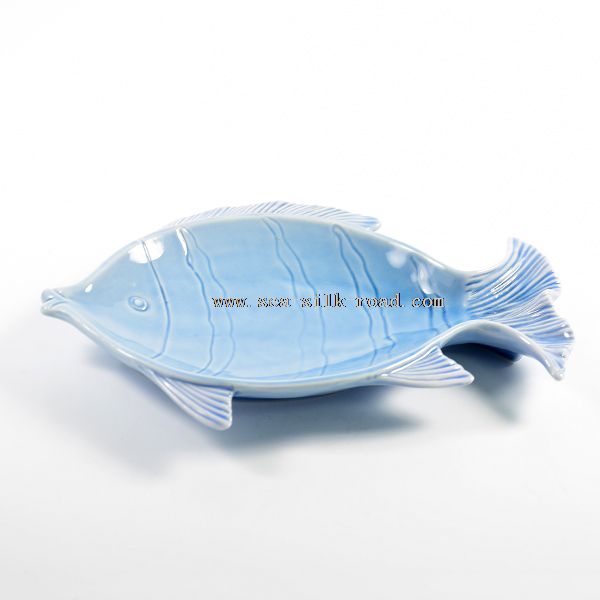
Here stoneware usually has the edge. Its slightly softer, less glassy body absorbs an edge knock that can chip porcelain. That does not make stoneware unbreakable, but for a gift that will be posted, handed around an event or washed in a busy office, the margin is real. Ask how the pieces are packed: a moulded pulp insert that separates each rim does more for breakage than the clay choice alone. If you do choose porcelain for its finish, budget for individual cartons and confirm the drop-test height the supplier will stand behind. Decorative shapes with thin rims or handles concentrate stress, so test the exact silhouette you are ordering, not a round sample plate.
3. Weight and Freight
Porcelain can be thrown thinner for the same stiffness, so a finished piece is often lighter than its stoneware equivalent. On a single sample the gap looks trivial. Multiply it by several thousand units and a 40HQ container and it becomes a line item. Ask for the packed weight per piece and the carton cube, then compare landed cost rather than unit price. A cheaper stoneware piece that adds a pallet of freight can end up dearer delivered. Conversely, if the gift is a heavy desktop object where weight signals quality, the lighter body can feel insubstantial to the recipient. Decide whether weight is a cost to minimise or a feature to keep before you compare quotes.
The strength difference also shows up in tolerances. Stoneware bodies are more forgiving during forming and firing, so a complex shape holds its outline with less warping from piece to piece. Porcelain's higher shrinkage makes consistent dimensions harder on large or asymmetric items, which is worth knowing if the gift must fit a lid, a box insert or a display stand. Ask the supplier what dimensional tolerance they hold on the exact silhouette and whether they sort or match pieces before packing. For a simple plate or bowl this is a non-issue; for a fitted gift set it decides whether the components assemble cleanly on the recipient's desk.4. Glaze Finish and Print Behaviour
Both bodies take decoration, but the surface finish changes the result. Porcelain's smoother, whiter face gives sharper full-colour transfer prints and cleaner logos; stoneware's warmer, slightly textured surface suits embossed, debossed or single-colour marks. If the brand artwork is a fine-gradient logo, ask for a printed sample on the actual body rather than trusting a proof on paper. Confirm whether the decoration is under-glaze or on-glaze: under-glaze is more durable but limits the colour range and needs a longer production run. For a mixed SKU programme, keep the print method constant and vary only the shape, so approval and re-order stay predictable.
5. How to Decide and What to Sample
Start by naming the failure you cannot accept. If the item carries wet drinks and will be reused, prioritise low absorption and take porcelain. If it will be mailed or handled roughly and budget is tight, stoneware's chip margin may matter more. If freight dominates the landed cost, compare packed weights before comparing piece prices. Then order physical samples of both bodies in the exact shape and print you plan to ship, and run the absorption soak, a rim drop test and a print-rub check on each. Three samples from two suppliers cost little against a rejected container. Lock the clay body, glaze, absorption ceiling and pack format in one written spec so a re-order reproduces the same piece. Send us your artwork, quantity and destination and we will quote both bodies side by side with the packed weights, so the choice is made on delivered cost rather than a catalogue assumption.
Planning a promotional gift order?
Send your spec and target quantity for a quote and a digital proof.
Get a free quote