Sea Freight vs Air for Shoulder Bag: The 300kg Break-Even
The choice between sea and air for a shoulder-bag order is not decided by the freight quote. It is decided by chargeable weight, the date the goods must be on sale, and how much of the order can tolerate a slow, predictable route. Work out those three first and the mode usually picks itself.
Start with chargeable weight, not the rate card
Air freight is billed on the greater of actual weight and dimensional weight, using the carrier's divisor (commonly 6000 for standard air cargo). Shoulder bags are light but bulky, so a carton that weighs 12 kg can be billed as 20 kg or more once its dimensions are converted. Sea freight is generally charged by cubic metre or by a weight/measure comparison, which treats volume more gently. The practical consequence: the heavier and denser the carton, the smaller the air premium; the lighter and bulkier it is, the wider the gap. Measure the real export cartons — length, width, height and gross weight — before you ask for either rate. A quote built on guessed dimensions is a quote you cannot compare.
Put those numbers into one sheet: carton count, per-carton cube, gross weight, and total volume. That sheet is the basis for every comparison below, and it is the same sheet the forwarder needs. Recalculate it whenever the packing changes, because a switch from hangtags to individual polybags can move the dimensional weight enough to change the answer.
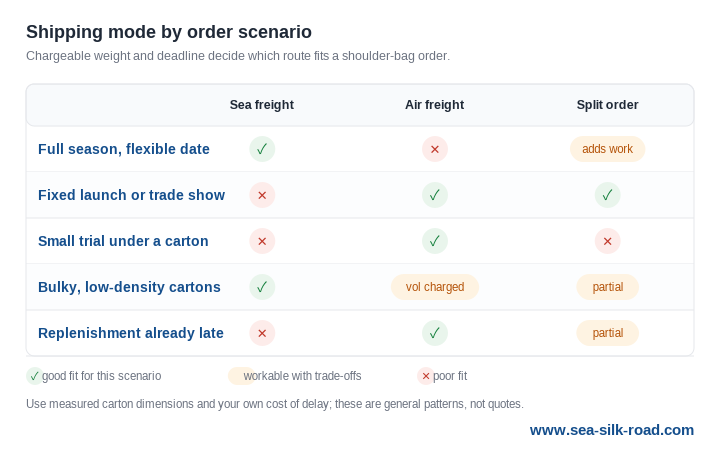
Where sea freight wins
Sea wins when the order is large, the launch date is flexible, and the product holds value in a warehouse without tying up cash unhelpfully. A shoulder-bag programme with a full season's runway — colours that will sell for months, not a one-week promotion — is a natural sea candidate. The transit is longer but the per-unit cost falls as volume rises, and a container gives you room to absorb a packaging change without repricing the whole shipment. The discipline sea freight demands is a schedule: book against a cut-off, confirm the packing list early, and allow buffer for a missed sailing rather than assuming the first departure.
Where air freight wins
Air wins when the goods must land against a fixed date: a trade show, a store reset, a promotion tied to a campaign, or a replenishment that is already late. It also wins for small trial orders where the fixed costs of a container dominate. A few cartons of sample-quality bags sent by air can be cheaper in total than a less-than-container load with its minimum charges and destination handling. The trap is to let an air shipment become routine: once a buyer relies on air to rescue a late production run, the underlying scheduling problem never gets fixed and the premium is paid every season.
Find your own break-even point
The break-even is the order size at which the extra cost of air equals the cost of the delay it avoids. Express both as a per-unit number. Air adds a premium per kilo of chargeable weight; delay costs you the margin on sales you cannot make while the goods are in transit, plus any penalty for a missed delivery window. Divide the fixed and per-unit pieces by the number of units, and the point where the two lines cross is your answer. For most fashion accessories that point moves with the selling season: a bag with a long life tolerates a longer route, while a trend item loses value every week it is late. Recompute it for each programme rather than adopting a rule of thumb from a previous order.
Check the hidden costs on both routes
Compare the whole landed cost, not the line item. Sea freight carries destination charges, terminal handling and inland haulage that can be quoted separately, and a less-than-container shipment may carry a minimum charge that makes a small order uneconomic. Air freight carries fuel surcharges, screening fees and, at some airports, a handling minimum that is easy to miss in a headline rate. Ask the forwarder for an all-in figure to your door for both modes, using the same carton data, and confirm what is excluded — duties and any inspection costs are usually separate. A difference that looks decisive on the rate sheet can narrow once the destination side is included. The comparison is only fair when both columns describe the same delivery point.
Consider splitting the order
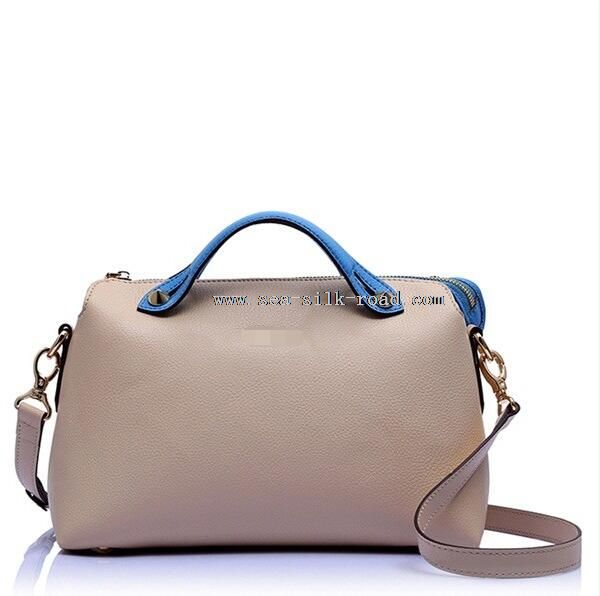
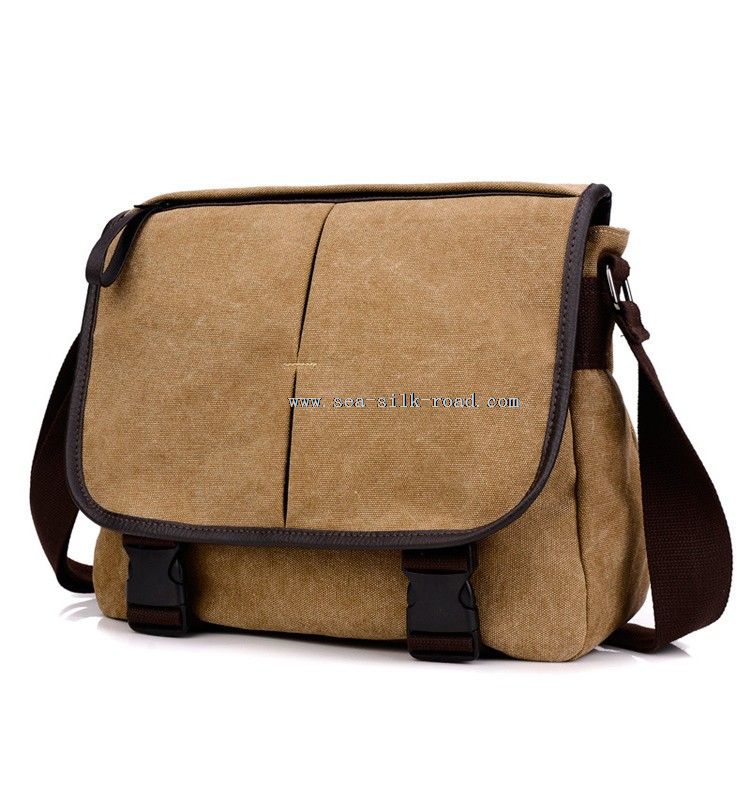
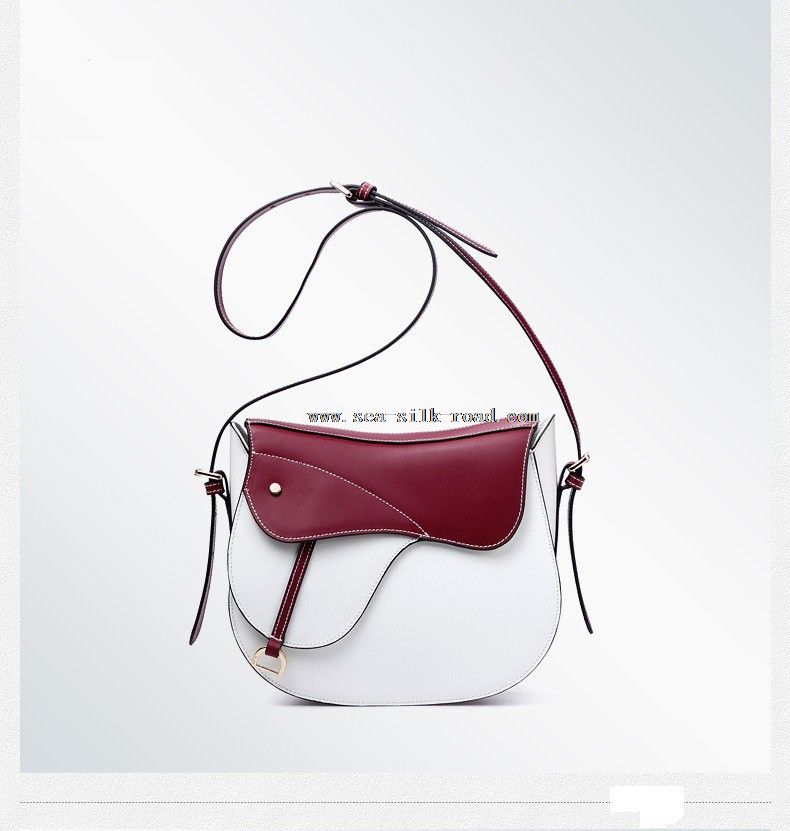
You do not have to choose one mode for the whole order. A common pattern is to air-freight the fast-moving colours or the sizes that sell first, and send the balance by sea. The air portion covers the launch window; the sea portion arrives in time to replenish. This works best when the SKUs are clearly separated and the carton plan supports it — ask the factory to pack the air portion as complete, labelled cartons so the forwarder is not opening mixed boxes at the airport. It also helps to keep one master packing list across both modes so the receiving team can reconcile what lands on each date. See our shoulder bag range for styles that pack and ship predictably. Request a free sample and quote and ask for the export carton dimensions so your freight comparison starts from real numbers.
Planning a promotional gift order?
Send your spec and target quantity for a quote and a digital proof.
Get a free quote