Bag Logo Methods Compared: Embroidery, Deboss and Metal Plate
Logo method decides more than how a bag looks. On a 500-piece run it sets the tooling you pay for, the material grades you can actually use, the defect rate at final inspection, and whether the mark survives a year of daily handling. Embroidery, deboss and metal plate each fail in a different place, so the useful question is not which one photographs better but which one your material and your volume can carry.
The three mechanisms are not decorative variants
Embroidery pushes thread through the panel and locks it with a second thread underneath. Deboss presses a heated plate into the surface and relies on the material remembering the shape. A metal plate is a separate part fixed to the bag by rivets, screws or adhesive. Because the mechanisms differ, the things that go wrong differ too: embroidery puckers thin material, deboss fades where the surface has no memory, metal plates loosen at the fixing points.
Buyers who ask for "a logo like the sample" without naming the mechanism are comparing three processes with different tooling, labour content and failure modes. Ask which mechanism the sample used before you price the order, and put the answer in the purchase order.
Embroidery: specify density, backing and minimum text height
Embroidery adds a dimension to the surface, which is why it reads well on canvas, cotton and coated fabric. What decides quality is not the colour count but the stitch build: ask for density in stitches per centimetre rather than "normal density" — 7 to 9 per centimetre is the usual band for bag panels, and going denser on soft material makes the panel cup.
Three specifications do most of the work:
Backing. A cut-away or tear-away stabiliser behind the stitch field keeps the panel flat. Without it, a 40 mm logo on 0.8 mm PU will pucker within the first wash or the first humid week in a warehouse.
Minimum text height. Below roughly 5 mm cap height, letter counters close up and the logo turns into a blob. If your artwork has fine print, either enlarge it or move that element to a woven label.
Thread and colour count. Standard 120D/2 polyester thread is the workhorse; it takes dye consistently and resists UV better than rayon. Each additional colour is a machine stop, so a 6-colour logo costs more in labour than a 2-colour one at the same stitch count — worth knowing before you approve a 9-colour design for a 300-piece order.
Deboss: depth, temperature and what the material can hold
Deboss is the cheapest way to put a mark on PU, split leather and firm microfiber, and the most sensitive to material thickness. A heated plate presses the surface down by 0.3 to 0.5 mm and the surrounding material has to stay flat while it cools. If the panel is thinner than about 1.0 mm, or backed with soft foam, the press leaves a dish-shaped shadow instead of a crisp edge.
Ask the factory for the plate depth and the press settings in writing: typically 120 to 140 °C for PU with a dwell of 0.5 to 1.5 seconds, adjusted by the material's recovery. Then test recovery, not just appearance. Deboss a scrap panel, leave it 24 hours at room temperature, and look again. A logo that springs back halfway will be unreadable after a season.

Foil stamping behaves differently: the foil is a transfer, so it sits on the surface and wears at the high points of the grain. On a textured PU it loses its top layer first. Deboss with colour fill keeps the mark inside the material and wears more evenly, at the cost of one more press pass.
Metal plate: fixings matter more than the finish
A metal plate is the most durable of the three and the one most often specified badly. Buyers spend their attention on plating — brushed nickel, antique brass, matte black — and then accept a fixing that fails. The plate itself is usually 0.3 to 0.6 mm brass or stainless; what determines whether it stays on the bag is how it is attached.
Four-leg rivets through the panel are the most secure option on material thicker than 1.2 mm, because the legs fold behind the lining and spread the load. Screw posts work on rigid panels and can be replaced, but they loosen with vibration. Adhesive-only plates suit gift boxes, not a bag picked up by its hardware.
Two checks settle the argument. First, a pull test on the finished sample: hang a known weight from the plate edge for a minute and inspect the panel for tearing around the legs. Second, a salt-spray or simple rub test on the plating — 20 minutes of thumb abrasion on one spot shows whether the finish is real plating or a sprayed coat that will discolour at the edges.
Choosing by volume and material, not by preference
Volume changes the answer. Embroidery carries almost no tooling beyond the digitised file, so it scales down to small orders; deboss pays off only once a run can spread the cost of a cut steel plate; metal plate carries two fixed costs, a die and a purchased part.
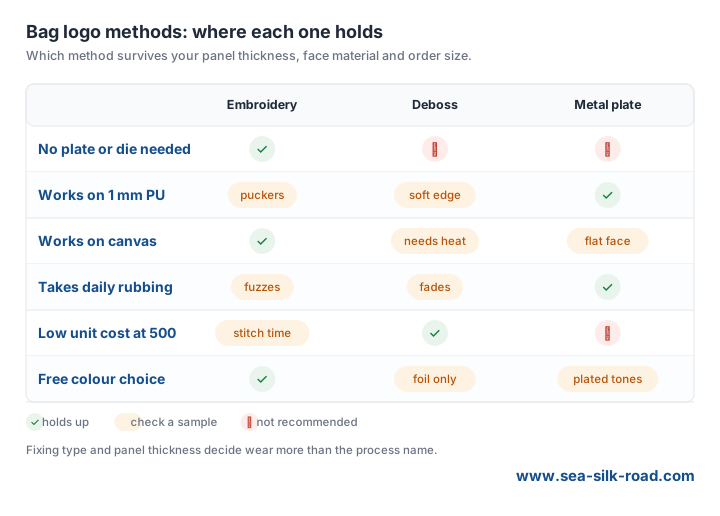
Material narrows it further. Canvas, cotton and coated woven fabric take embroidery well; firm PU and split leather take deboss; anything with a hard, flat face — a metal frame, a rigid flap, a boxy satchel — can take a plate. Across a mixed range, the practical answer is one mechanism per material family rather than one for the whole order.
What to put in the sample approval
Approve the mechanism, not the photo. Photograph the logo at 1:1 with a ruler in frame so size and depth can be measured later. Record the stitch count or plate depth, the thread or foil reference, and the plating name. Note the panel material and thickness beside the logo, because the same tool behaves differently on a 0.8 mm and a 1.4 mm panel.
Then handle the sample the way a customer would: fold the panel, rub the mark, hang a load from the hardware. Fifteen minutes of that tells you more than a page of specification. Once the mechanism, the settings and the material are fixed in writing, reorders stop depending on who runs the press that week. Browse the rest of the handbags range for shapes that suit each method before you commit the tool.
Planning a promotional gift order?
Send your spec and target quantity for a quote and a digital proof.
Get a free quote


