PU vs Genuine Leather Handbags for Bulk Orders: 5 Points to Test
Put a PU handbag and a leather handbag of the same silhouette on a table and most buyers cannot separate them at arm's length. The difference that decides a bulk order is not day-one appearance. It is how many of the 500 units still match each other on day 300, and whether you can reorder the same colour next season. Five tests on a sample answer that in about ten minutes, and four of them need nothing more than your hands and a pair of calipers.
This is written for buyers placing 300 to 3,000 sewn bags, where the material choice drives both unit cost and complaint rate. It assumes you hold a sample of each; choosing from photographs means the choice is being made for you.
Read the thickness and the backing before you touch the face
Cut nothing yet. Turn the bag inside out and look at the back of a panel through the lining opening, or ask for a 10 cm scrap from the inside seam. Coated fabric is a textile core with a polymer skin: you should be able to see a woven or non-woven backing, and the skin should be bonded to it without bubbles or a loose edge. Leather is a single sheet, and a split leather has a coated surface over a fibrous back that looks like suede.
Measure with a caliper at three points on the same panel, not one. A handbag body in coated fabric usually runs about 1.2 to 1.4 mm with the backing included; garment-weight leather for the same panel typically sits at 1.2 to 1.6 mm, and structured styles go thicker. What matters is the spread: three readings within 0.1 mm on one panel is a controlled material, while a 0.3 mm spread means the mill is supplying to a range and your cutting room will fight it later. Write the measured range into the purchase order, not the word "standard".
Fold it and watch the crease recover
Fold a scrap face-to-face, press the fold with your thumb for three seconds, then open it. Coated fabric tends to hold a soft line that fades; on a poor coating the fold line turns lighter or shows fine cracks along the ridge. Leather creases with a visible grain break, and full-grain leather recovers most of its shape after a few seconds of handling. Split leather with a heavy coating behaves closer to coated fabric than to full-grain, which is exactly why the two get confused in quotes.
Repeat the fold in the same place five times. This is the closest you get to simulating a bag that is opened and closed daily for a year. A coating that whitens at fold three will show at the top edge of every bag in the carton, because that is the part the customer touches. If the sample whitens, ask for a different coating weight or a different base fabric before you talk about price.
Look at the edge, not the face

Edges are where the material announces itself. A coated-fabric bag usually has a painted edge: a bead of edge paint folded over the cut, visible as a slightly raised, glossy line. Leather is more often burnished — sanded, gummed and waxed until the fibres fuse — or folded and stitched with no paint at all. Both are legitimate. Neither is legitimate when it is inconsistent.
Run a fingernail along 20 cm of top edge and look for paint sitting proud in one place and thin in another, or a burnish gone fuzzy where the wax was skipped. Then check the same edge inside the opening, the part nobody photographs. A supplier who paints the visible edge and leaves the inside raw is pricing to the photo.
Smell it, then wet a corner
Smell is a crude instrument, but it is a fast one. Leather smells of hide and tannage; coated fabric smells of polymer, and a strong solvent smell on a freshly opened carton usually means the coating has not fully cured. That smell transfers to whatever the bag is packed with, and for gift or retail packaging it is a return reason.
For the water test, put a drop of water on the face and leave it two minutes. On coated fabric the drop should bead and wipe off with no dark mark. On untreated full-grain leather it will darken the surface and dry back; that is normal and is what conditioner is for. On split leather with a thin coating, the drop often leaves a ring, which means the finish is not continuous. Ask what the finish is called and how many coats, and expect a specific answer rather than "waterproof".
Check reorder colour and carton weight
Two numbers decide your second order. The first is colour repeatability: coated fabric is produced in rolls against a lab dip, so a reorder six months later can match closely if the mill keeps the recipe; leather comes from hides, and no two dye lots are identical. If your product needs 500 bags in exactly the same pink, leather will cost you a sorting step that nobody quoted. Ask to see a production run photo from a previous lot in the same colour, not a swatch.
The second is carton weight. Coated fabric at the same silhouette is usually lighter, which shows up in freight rather than in the unit price. Weigh one packed carton of each on the same scale and multiply by the carton count. On a 3,000-piece order the freight difference can be larger than the per-unit material difference, and it is the line item buyers forget to put next to the quote.
Put the result in the purchase order
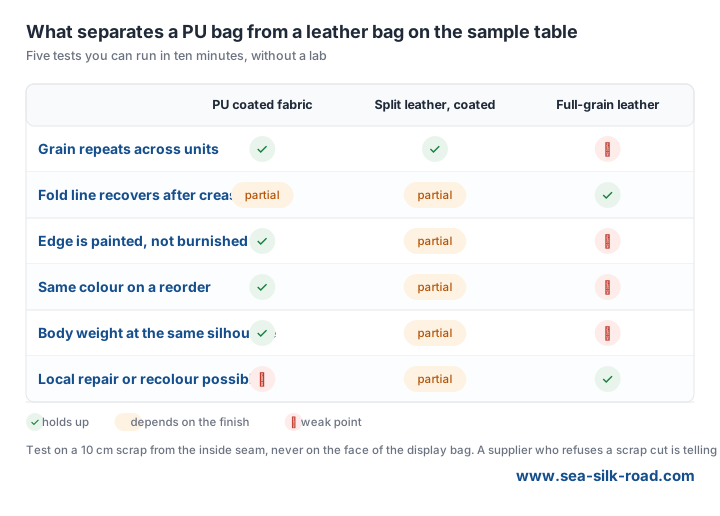
Then write five lines into the purchase order and no adjectives: material and backing type, measured thickness range with the caliper points named, edge treatment for both the visible edge and the opening, finish coats with the water-drop result, and the colour reference with the dye-lot tolerance you will accept. Attach the approved sample and keep a cut scrap with the order — when the second shipment arrives, that scrap is the only document that settles an argument about whether the material changed.
Planning a promotional gift order?
Send your spec and target quantity for a quote and a digital proof.
Get a free quote


