Tote Bag Fabric Weight: 8oz vs 10oz vs 12oz Canvas
Fabric weight is the first number that decides what a tote bag can carry, and the three canvas weights quoted most often sit about 68 gsm apart. Converted: 8 oz is roughly 271 gsm, 10 oz about 339 gsm, 12 oz about 407 gsm. That gap is what your hand feels as stiffness at the top edge, what the printer feels as ink hold-out, and what the sewing floor feels as needle deflection. It is also the line item that explains why one quote runs 20 percent above another for a bag that looks identical in a photo.
What follows is the arithmetic behind picking one, the jobs each weight suits, and three checks to run on a sample first.
Convert the number before you compare quotes
Two suppliers can both say "10 oz canvas" and mean different cloth. The unit that removes the ambiguity is grams per square metre. One ounce per square yard equals 33.9 gsm, so the conversion is mechanical: multiply the ounce figure by 33.9 and weigh the result against a swatch. Ask for gsm or oz/yd² explicitly, never "10 oz" alone, because some mills quote ounces per linear yard, which depends on roll width and says nothing about the cloth.
Weight is not thickness, and neither is density. A 10 oz canvas woven from coarse yarns at a loose sett can measure thicker than a tight 12 oz, yet deflect further under the same load and let screen-print ink strike through sooner. If a sheet gives weight only, ask for yarn count and ends-and-picks, or accept that you are buying a number rather than a hand-feel. A mill declaration of plus or minus 5 percent is normal for cotton canvas, so write the tolerance into the order instead of assuming exactness.
What each weight is actually good for
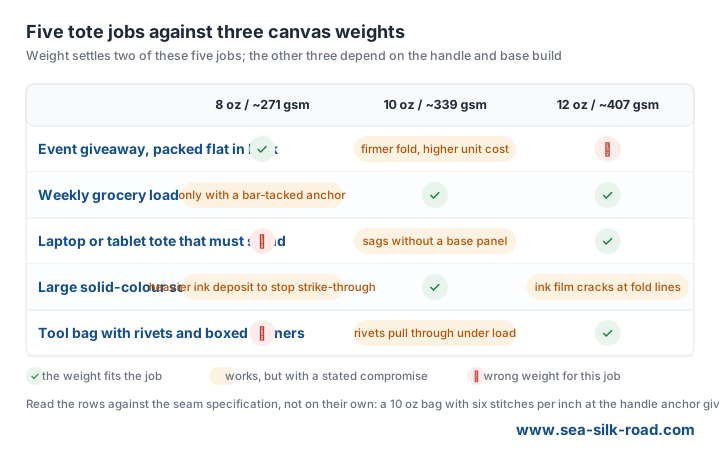
8 oz at roughly 271 gsm is a folding bag. It packs flat, takes a fold line that stays, and prints well across a large area because the surface is smooth relative to heavier goods. Its limit is structure: an unlined 8 oz tote will not stand on a table, and with a single row of stitching at the handle anchor it gives at the top band well before the body wears out.
10 oz at roughly 339 gsm is the retail default. It holds a full grocery load without the base bowing, folds to a usable stack height for shipping, and accepts a boxed corner without the corner seam puckering.
12 oz at roughly 407 gsm is a structured bag. It holds a shape, takes rivets without tearing out around them, and reads as a product rather than a giveaway. The costs are real: heavier needle and thread, slower sewing, harder corners to turn, and a unit that will not fold flat for economical cartoning.

Handle attachment is where weight stops mattering
A heavier body does not save a weak anchor. The load path runs from the handle, through the anchor stitching, into the top band, and that joint fails before the cloth does in almost every return. Three numbers govern it: stitch density at the anchor, bar-tack length, and webbing width.
Stitch density of 7 to 8 stitches per inch is what most canvas workshops run, and going denser weakens the cloth by perforating it rather than strengthening the seam. A bar-tack of 12 to 16 mm across the handle ends spreads the peel load. Webbing of 25 to 38 mm folded into the top band, rather than stitched onto its face, keeps the pull in shear instead of peel. An 8 oz bag built this way outlasts a 12 oz bag with a single row of stitches and no bar-tack.
Test it rather than argue it. Load the bag with 10 kg, hang it from both handles on one hook so the base carries nothing, and measure from the top edge to the centre of the base seam at hour zero and hour twenty-four. Under 3 mm of growth is a bag holding its geometry; 10 mm or more means the anchor is stretching and will keep stretching.
Print, wash and shrinkage behave differently at each weight
Screen printing on 8 oz needs a heavier ink deposit to stop strike-through, and a heavier deposit needs more cure heat, which is where scorching comes from. On 12 oz hold-out is better, but the ink film sitting on a coarse weave can crack at fold lines when the bag is compressed in transit.
Shrinkage is the number buyers most often forget to ask for. An unwashed cotton canvas can move 3 to 5 percent in length after the first wash; pre-shrunk or garment-washed goods typically land under 2 percent. If the bag carries a printed registration mark or a label positioned to a millimetre, that difference is the whole tolerance. Washed finishes also soften a 12 oz cloth enough that it drapes closer to a 10 oz — a legitimate way to get structure without stiffness.
Three checks that settle the choice on a sample
First, weigh the cloth yourself. Cut a 100 mm by 100 mm swatch, weigh it on a scale readable to 0.01 g, and multiply the gram figure by 100; 3.4 g is 340 gsm. Three swatches from different places in the roll tell you whether the roll is consistent.
Second, run the 10 kg hang on a finished sample, not a flat panel, because the anchor is what you are testing. Third, do a fold-and-recover check: fold the empty bag along the same line five times, press it flat, then look at the crease. A crease that stays white and sharp on a dark dyed cloth means the dye is failing at the fold, which no weight increase will fix.
Write the weight, the tolerance and the seam spec on the order
A purchase order that says "canvas tote, 10 oz" invites three different cloths across three deliveries. One that says "340 gsm plus or minus 5 percent, 7 to 8 stitches per inch, 14 mm bar-tack at both handle ends, webbing folded into the top band, pre-shrunk to under 2 percent" gives the factory something to fail against.
Keep the sample that passed the three checks, tag it with the date and the weight you measured, and compare each bulk delivery to that tag rather than to memory. That comparison is a scale reading and a tape measure. Browse the tote bags category to see which weights the current range uses, then order the swatch set before the carton.
Planning a promotional gift order?
Send your spec and target quantity for a quote and a digital proof.
Get a free quote


