Lunch Cooler Bag Insulation: PE Foam vs EPE vs Aluminum Film
Insulation in a lunch cooler is still air, held in place. PE foam, EPE and aluminium film are three ways of holding it, and at the same thickness they are not interchangeable. One is dense and cheap, one is light and bulky, one blocks radiant heat but barely slows conduction. The lining name on the spec sheet tells you which mechanism you are buying, not how long the bag holds cold.
This is for the buyer who has to defend a lining choice in a meeting and then live with it for a run: what each build does, why thickness outranks the label, where cold leaves the bag, and an ice test for three samples.
What each lining actually does
PE foam is closed-cell polyethylene, usually 2 to 5 mm, laminated to a PEVA film or a metallised backing. The cells are sealed, so the foam does not take up water and still insulates after a spilled drink. Thermal conductivity sits around 0.035 to 0.04 W/(m·K). It is the cheapest way to buy a given thickness, and it creases permanently once the tote is folded flat.
EPE, expanded polyethylene and sold as pearl cotton, is the same polymer expanded to a much lower density. More air per millimetre, less material per millimetre, but also less body: a 3 mm EPE wall behaves like a thinner PE wall, so EPE totes are normally built at 5 to 8 mm to land in the same place. What EPE gives back is recovery — it springs back after being compressed in a carton and still looks right on a retail peg.
Aluminium film is a metallised PET or foil laminate with low emissivity, commonly 0.05 or lower. It reflects radiant heat instead of resisting conducted heat, and only earns that behaviour with an air gap in front of it. Foil bonded straight onto fabric with no foam behind is a radiant barrier and little else, which is why the honest versions of this build are foil over foam or foil over bubble.
Thickness outranks the material name
At equal thickness, closed-cell PE measures slightly better than EPE because its cells are smaller and its density higher; the gap in thermal resistance is roughly 10 to 15 percent, not the twice-as-warm that suppliers imply. Change thickness instead and the number moves in proportion: resistance scales with wall thickness, so 6 mm of EPE beats 3 mm of PE comfortably. Buyers who argue about material while holding thickness fixed are arguing about the smaller variable.

A workable envelope for a soft lunch cooler bag: 3 mm total foam for a two-hour commute with one ice pack, 5 mm for a half day at a desk or in a school bag, 8 mm plus a sealed lid if the bag lives in a car through the afternoon. Past 10 mm the tote stops folding flat and the extra millimetres buy less than the first ones did.
Where the cold actually escapes
Three places, in this order of damage: the lid seam, the zip tape, the handle anchor.
The lid seam is where foam is usually discontinuous. A lid built as a separate panel joined by binding tape leaves a line with no insulation across it, sitting directly over the food. Press a thumb along the inside of the hinge and feel for a hard band under the lining — that band is the bridge. A one-piece wrap that folds without a cut, or a lid insert carried past the hinge, is what to ask for.
The zip tape interrupts the wall by design: coil, tape and stitch row all pass through the insulation. An insulated flap sewn over the closed zip recovers most of what the tape loses, and it is the cheapest upgrade on a soft cooler. Close the bag, run a finger along the zip line, feel for a cold strip; then repeat after ten open-close cycles, because a flap that will not lie flat again is worse than none.
The handle anchor is a quiet one. Webbing stitched through the outer shell and the foam leaves a row of needle holes across the insulation, and a loaded bag pulls them open. Check whether the anchor bar stops at the outer shell over a reinforcement patch, or whether the stitch row goes through both walls. The first is correct; the second is a leak you find on the ice test, not on the drawing.
An ice test that takes one afternoon
Put 500 g of cubed ice in a sealed bag inside the sample, close the lid, and stand the tote in a room at 30 °C. Weigh the meltwater at two, four and six hours through a sieve, so you weigh water and not ice. Absolute figures will not match a customer's kitchen and are not meant to: the ranking between samples is the point.
Run every sample the same day in the same room, with fresh ice at each interval. A 3 mm PE tote with one ice pack is mostly melt by hour four, and when it fails early the cause is usually a wet lid seam rather than thin foam — the water tells you where the heat came in.
One free improvement before blaming the lining: pre-chill. Load the ice pack alone for twenty minutes, then add food. A cold wall takes up less heat in the first hour, and over a two-hour window that makes a 5 mm tote behave closer to an 8 mm one.
Matching the build to the order
The choice is not "best lining" but "which claim the customer will test". A promotional tote carrying a sandwich from a car park to a desk needs cheap foam and a lid that closes; a bag sold for a full day out needs thickness, a zip flap and a clear statement that it is not a cooler box. If the promise reaches chilled food transport or anything temperature-logged, a soft tote is the wrong product whatever the lining.
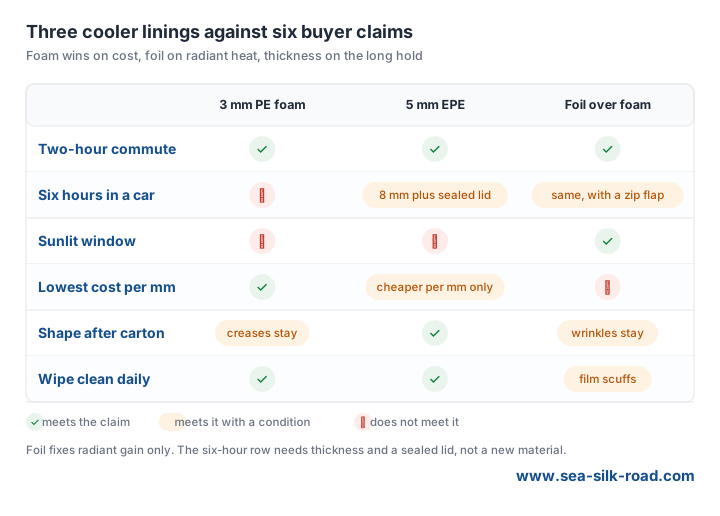
Put five lines in the purchase order and the next run will be the same bag: foam type and thickness in millimetres, lining grade with its food-contact declaration, lid construction, whether an insulated zip flap is included, and the ice-test result for the approved sample. Everything else on a soft cooler is cosmetic, and cosmetics are where the cost difference hides.
Planning a promotional gift order?
Send your spec and target quantity for a quote and a digital proof.
Get a free quote


