Briefcase Bulk Order Spec Sheet: 7 Fields Buyers Forget
Seven lines decide whether a 500-piece briefcase order arrives as one product or as five variations of it. None are exotic, and all are missing from the enquiry template most buyers send. This is the spec sheet we ask a factory to fill in before a sample is cut, written the way it should appear in a purchase order, because "good quality leather" and "YKK zipper" are not specifications and cannot be inspected.
It is written for orders of 300 to 3,000 pieces, where one ambiguous line gets multiplied by the whole run, and it works the same for a soft body, a structured attaché, or a nylon-leather hybrid.
Panel grade, measured thickness, and where splitting is allowed
Name the hide, the grain, and a thickness range for front and back panels, then state where a split is acceptable. A workable line reads: full-grain cowhide 1.4 to 1.6 mm on front, back and flap; split leather permitted on gusset and internal pockets; measured with a caliper at three points per panel and recorded on the approval sheet.
Split the requirement by panel for cost and structure at once. Gussets take the fold and the abrasion, so a slightly thinner corrected-grain hide there cuts both cutting loss and the bulk that makes a bag feel rigid. Put the heavier hide where a buyer's hand lands: the flap and the front panel.
Three readings per panel matter more than the single number. Within 0.2 mm of each other, the material is controlled and the cutting room gets consistent yield; a 0.5 mm spread means the tannery is supplying a range, and the symptom appears later as bags that stand differently on a shelf.
The lining is where the cheapest line in the quote hides
Two briefcases can share a costed body and differ by a third on the inside. Ask for fibre and weight: 210D polyester oxford, 190T taffeta, and cotton canvas are three different products with three hand feels, and the quote calls all three "polyester lining".
Attachment matters more than the cloth. A lining glued along the top edge with no stitch line lifts in humid storage, and the failure shows up at retail, not at inspection. Write: lining sewn into the top seam and the zip seam, glue permitted only as an assembly aid. Add colour fastness against rubbing, because a dark lining that bleeds onto a cream interior is a return, not a defect claim you can win.

Turn it inside out through the zip and you can read the lining attachment, the seam allowance, and the interlining in one look. A supplier who will not allow that with a sample has already answered the spec question.
Zipper, slider, feet, and the parts that fail first
Hardware separates a two-year bag from a ten-year bag and is the easiest field to specify. Write four things: zip gauge, tape length in centimetres, slider type with a locking pin, and nylon or metal coil. A 38 cm main opening on a leather body usually carries an 8-gauge coil; a 5-gauge on the same opening reads as undersized the moment a buyer pulls it with a full bag.
Then the small parts: base feet (four or five, screwed or riveted), the handle anchor, and the lock or magnetic closure. Screwed feet can be replaced by a customer, riveted feet cannot, so make that a decision rather than an inheritance. Name the hardware finish and its test: brushed nickel, antique brass, or matte black, each with a salt-spray requirement in the order so plating failure becomes a measurable claim.
Handle drop and the load it has to carry
Handle drop is the distance from the top of the handle arc to the top edge of the bag, and it is the field buyers leave to the factory. On a hand-carried briefcase, 8 to 12 cm keeps the bag clear of the floor at your side; under 7 cm it presses against the leg, over 14 cm it swings and reads as a tote.
Specify the attachment with the drop: how many stitch rows through the anchor patch, whether rivets pass through an interlining, and what the handle is made of. Rolled leather stretches less than a flat strap. Then add one acceptance test a QC person can run without equipment: load the bag to its working weight, hang it by the handle for an hour, measure the drop again. A drop that grows by more than a few millimetres means the anchor is moving.
The laptop sleeve needs three measurements, not a screen size
"Fits a 15-inch laptop" is a marketing line, not a dimension. Give the sleeve a width, a depth, and a corner radius, plus the tolerance across units. A sleeve at 26 by 36 cm with square corners will not take a machine with rounded corners and a rubber foot; the same sleeve with a 2 cm radius will.
Padding is the second half of the field. Specify foam thickness on both faces and whether the bottom edge is padded as well, because that is where a bag is set down and where most sleeves fail. Add the tolerance in writing: a 3 mm drift on sleeve width across a run is normal, 10 mm means the pattern was re-cut without telling you.
Stitch density, thread, and the carton that sets landed cost
Stitch density on leather goods usually lands at 7 to 8 stitches per inch; below 6 the seam looks coarse, above 9 the needle perforates the hide and creates a tear line. Name the thread, bonded nylon in a stated ticket size, and say whether the edge is painted or burnished. Painted edges hide splitting, burnished edges show it, which is why two similar samples differ by a full finishing step.
Packing closes the sheet and changes landed cost without touching the unit price. Write pieces per polybag, whether a divider goes between units, pieces per carton, and a carton weight ceiling one person can lift. Then confirm carton dimensions, because 60 by 40 by 40 cm and 55 by 35 by 38 cm hold the same count on paper and load differently in a container.
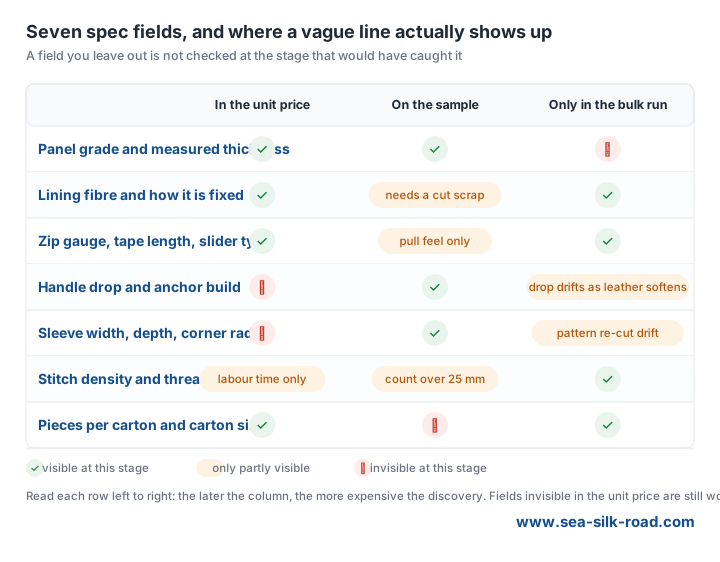
Send the seven fields as a table with an empty column and ask for values returned measured, not confirmed. A quote that comes back with measured thickness, a named zip gauge, and a carton count is comparable with another quote. One that comes back "as per your requirement" is a price for a different product, and the difference surfaces at the loading dock.
Planning a promotional gift order?
Send your spec and target quantity for a quote and a digital proof.
Get a free quote


