Porcelain Gift Set Sourcing: 6 Decorating Methods and Their MOQ
Six decoration methods cover almost every porcelain gift set sold into corporate and retail programmes, and each one fixes its own minimum order quantity before anyone discusses the blank. Buyers who choose the piece first and the decoration second end up committed to a four-colour decal on a programme that only needed three hundred units. The sequence that works is the reverse: decide the decoration against the quantity you can sell, then pick the blank whose glaze can carry it through firing.
The six methods, and the one property that separates them
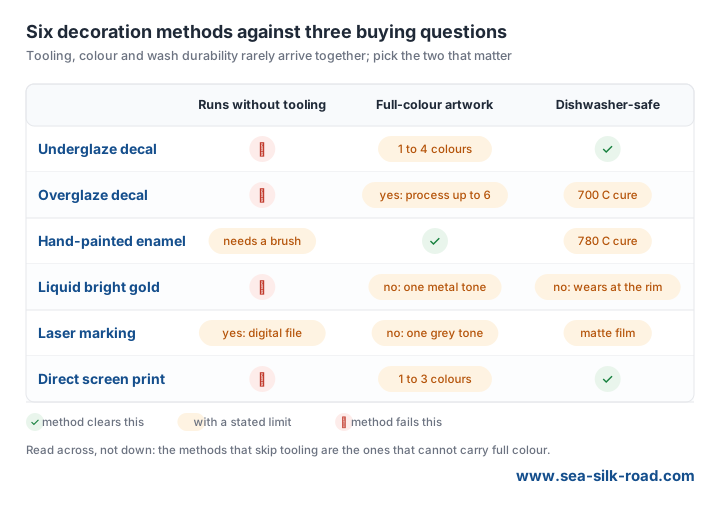
Underglaze decal is printed onto the bisque body, then covered by glaze and fired with it, which puts the colour under glass instead of on top of it. The palette is restricted, because the oxides that survive that heat are a short list and bright clean reds are the usual casualty. Overglaze decal is printed on transfer paper, applied to a glazed and fired piece, and fired again at roughly 780 to 850 degrees Celsius, which buys an almost photographic palette in exchange for colour that sits on the surface. Direct screen printing pushes ceramic ink through a mesh onto the glazed body and fires in the same range, and it rarely goes past three colours before the cost climbs above a decal.
Hand-painted enamel uses the same overglaze chemistry with a brush, fired around 750 to 800 degrees Celsius, and priced by the hour rather than the print. Liquid bright gold is a resinate carrying roughly eight to twelve percent gold, brushed or screened on and fired in that window, giving a mirror finish that is a thin film rather than a plating. Laser marking is the outlier: a CO2 laser removes a shallow layer of glaze or fuses a marking compound onto it, needs no screen or plate, and yields a single matte grey or white tone.
MOQ comes from tooling, not from the kiln
A kiln does not mind firing ten pieces or a thousand, so the minimum on a decorated set is almost always tooling cost divided by what the buyer will accept as a per-unit load. Ask for those two numbers separately, the tooling line and the MOQ, then divide them yourself. If a four-colour decal needs four screens plus a proof run and the supplier puts that at 320 in total, and your decoration budget is ten cents a unit, the artwork needs 3,200 pieces before it has paid for itself. A quote showing a 500-piece minimum against the same tooling is not generous; it is either a stock design from the supplier's library or a difference to be recovered inside the unit price.
The same arithmetic explains why laser marking quotes at low quantities: there is no screen to amortise, so a two-hundred-piece run of named pieces is a question about machine minutes. Direct screen printing sits between the two: one screen per colour, so a single-colour logo travels on a small order, while a second colour roughly doubles setup.
Firing temperature decides how the set ages
Two gift sets can look identical in a photo and behave differently after twenty dishwasher cycles. Overglaze decoration, whether decal, screen print or hand-painted enamel, is a glass film fused onto the glaze, and hot detergent attacks that boundary. Underglaze decoration is sealed beneath the glaze and has no boundary to attack. Neither is automatically right, but the buyer should know which one is on the order: a set sold as a daily-use mug is a different specification from one that sits on a shelf.
Test it rather than argue about it. Run three cycles at 65 to 70 degrees Celsius with ordinary dishwasher powder, then compare the decorated area against a retained sample under the same light. Colour shift, a chalky patch, and gold that has gone from mirror to dull grey are three separate failures, and the gold goes first because the film is thin. Add a microwave statement to the specification as well: any set with a metallic rim is not microwave-safe, and a buyer who assumes otherwise will hear about it.

What to ask for before the bulk run starts
The approval sample is where decoration disputes are won. Ask for one production piece per colourway, pulled from the actual run and fired on the actual glaze. Ask for the firing temperature on the specification sheet rather than inferring it from the method's name. Ask whether the piece is a decal or a direct print, because the two have different edge behaviour: a decal leaves a film edge you can feel with a fingernail, a direct print stops where the mesh stopped, and either looks sloppy if the artwork was drawn for the other process.
If gold is quoted, ask for the content and for how the price is held, since the metal cost moves independently of the ceramic. If colour matters, send a physical reference rather than a screen value and have the match checked under a defined light; a red approved on a monitor and a red approved on a piece are rarely the same red. Ask what the artwork looks like on the second and third firing of the same screens, because screens wear and thin coverage appears in the second thousand.
Write the decoration as a line on the order
A specification that survives production reads like this: porcelain gift set, two pieces, overglaze decal, four colours, fired at 800 degrees Celsius, gold band omitted, dishwasher tested three cycles at 65 degrees Celsius against the approved sample, decal edge trimmed to the moulding line. Every clause removes a decision from the factory floor and a line from the complaint file. The blank then gets its own paragraph, naming the body, the glaze and the fired dimensions.
Buyers who write both paragraphs get a second benefit: quotes become comparable. Two suppliers at the same unit price are rarely selling the same set once the method, the colour count and the firing temperature are pinned down, and the cheaper quote usually turns out to be a direct print where the other was a decal. Browsing the porcelain range with the decoration already decided is a faster route to a workable quote than starting from the shapes and working backwards.
Planning a promotional gift order?
Send your spec and target quantity for a quote and a digital proof.
Get a free quote


