Glass Candle Holder Bulk Order: 5 Thickness and Finish Specs
Bulk glass candle holders fail in three places that no catalogue photo reveals: a wall thinner than the approved sample, a finish that turned out to be a different process than the one quoted, and a carton that survives the loading bay but not the last mile. All three are settled by what you write on the purchase order, not by the price per unit. A 500-piece run with a 0.4 mm wall difference and a swapped finish photographs correctly and reads as cheap on a retail shelf.
Spec one: wall thickness, measured where it decides the outcome
Ask for millimetres with a tolerance, never for "thick glass". A pressed tea light holder usually runs 2.5 to 4 mm at the rim wall. A stemmed holder for tapers is thicker at the foot and thinner up the stem, because the stem is drawn rather than pressed. Two numbers matter and they are not interchangeable: the rim wall decides how the piece feels in the hand, and the base decides whether it survives a candle burning to the end.
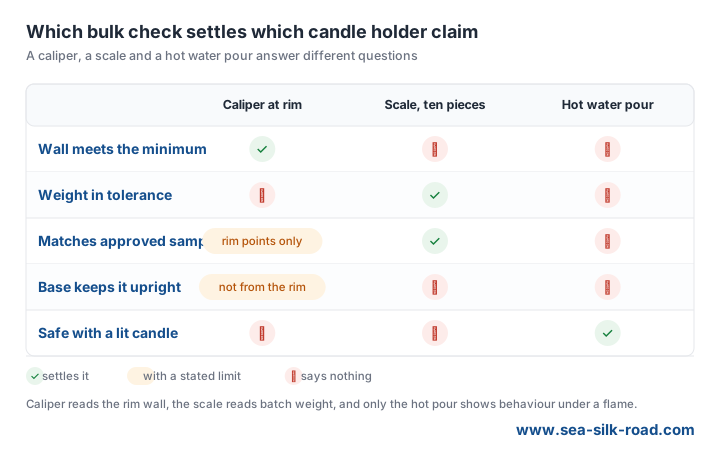
Measure with a caliper at four points around the rim, ninety degrees apart, on ten pieces pulled from the top, the middle and the bottom of one carton. A batch reading 3.0 mm on three points and 2.4 mm on the fourth has a gob-weight or mould problem, and the next carton from the same run will read the same way. Put the rule in the order: no single reading below the stated minimum, and no more than one reading below nominal on any single piece.

Spec two: base thickness, and the scale as your second opinion
The base is where cheap glass hides. A foot that is 8 mm at the centre and 5 mm at the edge passes a casual look and cracks when the candle wax reaches it. Ask for base thickness as a separate line, then verify it with weight instead of a section cut, because weighing is the only check a warehouse can run on every carton without destroying stock.
Weigh ten pieces on a 0.1 g scale and compare the spread, not just the average. On a holder in the 180 to 220 g range, a spread of more than about 3 percent across ten pieces signals inconsistent gob weight, and inconsistent gob weight is the same defect that produces thin walls. Record the average on the carton label. When a later shipment arrives at 165 g against an approved 200 g sample, you have a defensible rejection before the pieces reach a customer.
Spec three: finish, because the process sets the defect list
Four finishes cover most bulk orders, and each brings its own inspection list. Fire-polished glass has a glossy, slightly rounded rim and shows bubbles and mould seams most clearly. Sandblasted or frosted surfaces hide seams and show fingerprints, so they need a lacquer or a handled packing step. Sprayed colour is the finish most likely to be swapped, because a coloured opaque piece can be painted rather than tinted in the batch, and paint chips at the rim. Electroplated and mirrored finishes show every handling mark and need a protective film plus individual wrapping.
Insist the finish is named on the order with its process, not just its appearance: "interior spray, exterior sandblast" is a specification, "silver finish" is a wish. Ask for one piece of each finish in the approval sample and keep it. If the production run comes back glossier or more matte than the sample, the comparison is immediate rather than a matter of memory.
Spec four: annealing, the spec nobody writes down
Thermal shock is the failure that reaches the end customer, and it starts in the annealing lehr. Glass that cooled too fast carries internal stress that shows up as a crack when hot wax or a flame touches it, or when the piece goes from a warm room to a cold windowsill. You cannot measure stress with a caliper, but you can ask two questions that expose the risk: whether the factory runs a lehr at all, and whether it will hold a hot water pour test on production pieces.
The test is simple and needs no lab. Pour water at roughly 80 degrees Celsius into a room-temperature holder, empty it, and repeat three times on the same piece. A properly annealed holder takes it; a stressed one cracks at the base fillet. Run it on five pieces per carton from the first shipment and keep the results with the inspection record.
Spec five: packing, drop height and the carton cube
Glass in bulk is a packing problem before it is a product problem. Ask for the inner divider type by name, the number of pieces per inner box, and the carton's outer dimensions in centimetres, because those three numbers set your freight cost per piece. A carton that holds 24 pieces in individual foam sleeves usually cubes larger than one holding 36 in a moulded pulp tray, and the cheaper unit price can lose on freight.
Then agree on a drop test rather than a promise. A carton dropped on one corner and one edge from 80 cm onto concrete, opened and inspected, tells you more than any assurance about "strong export packing". Note the failures: chipped rims, cracks radiating from the base, and scuffed sandblast are three different problems with three different fixes.
Put the five specs on one page
The order sheet that prevents most disputes is short. Wall thickness in millimetres with minimum and tolerance. Base thickness as a separate figure. Weight per piece with the accepted spread. Finish named by process and by which surface it covers. Annealing confirmed with a hot pour test on production pieces, plus packing and drop height. Add the approval sample reference and the name of who signed it off.
That page also gives you a way to compare quotes honestly. Two suppliers at the same unit price are rarely selling the same glass; one is at 2.4 mm with a sprayed exterior, the other at 3.2 mm with a sandblast and a pulp tray. Once the five specs are written down, the cheaper quote stops looking cheaper, and the inspection conversation at the end of the run becomes a comparison against paper instead of an argument about taste.
Planning a promotional gift order?
Send your spec and target quantity for a quote and a digital proof.
Get a free quote


