Handbag Bulk Order Spec Sheet: 7 Fields Buyers Forget
A handbag order rarely fails because the factory ignored the brief. It fails because the brief left seven fields blank, and each blank was filled with whatever the pattern room did on the previous order. The result passes at sample stage and drifts by the bulk run: a 2 cm shorter body, hardware in the wrong gold, a lining that pills within a month. These are the seven fields that go missing most often, and how to write each one so a factory has no room to interpret it.
Fields 1 and 2: dimensions and material
Dimensions. "30 x 22 x 12 cm" is not a specification until you say where the tape sits. Height measured to the top of the body and height measured to the top of the handle differ by 8 to 12 cm on a tote. Depth at the base gusset and depth at the opening differ on any bag with a tapered profile. Write each dimension with its reference point: body height from base seam to top edge excluding handle, width at the widest point of the body with hardware excluded, depth at the base gusset on a flattened bag. Add a tolerance band, plus or minus 5 mm for soft bags and 3 mm for structured ones, and measure on a finished stuffed bag, because an empty PU satchel collapses and reads 3 cm short.
Material. PU is a coating, not a material. The same three letters cover a 0.6 mm PU on non-woven backing and a 1.4 mm PU on woven cotton backing, and the two behave nothing alike in a bag body. Specify the substrate, the coating thickness in millimetres, the backing fabric and its weight, and the surface finish: smooth, milled, embossed with a named pattern, or two-tone print. Do the same for the lining, which is where cost quietly leaves a bag: 210D polyester and 190T taffeta look identical in a photo and feel different in the hand within weeks. State the lining fabric, its weight and the colour reference, and attach artwork rather than describing a print.
Fields 3 and 4: hardware and internal build
Hardware. Hardware failures are usually a base-metal problem wearing a plating fault. Zinc alloy and iron look the same under light gold plating and behave differently within a season, because iron rusts through a thin plate at any scratch. Name the base metal, the plating family (light gold, antique brass, nickel, gunmetal, matte black) and the finish, polished or brushed. Colour is what breaks repeat orders: gold from two suppliers is two different colours, so pin it to a physical reference, a Pantone number for the plating or a signed swatch retained by both sides. Where a logo sits on the hardware, add the method and the plate size, since a 12 mm die will not fit a 9 mm puller.
Internal build. This decides whether the bag is usable and is the field most often summarised as "one zip pocket inside". Write the count and position of every pocket, the depth of each, whether a laptop sleeve is padded and to what thickness, and whether the base carries a stiffener board. Closure needs the same treatment: a zip is a size, a type and a brand tier, and a number 5 nylon coil is not interchangeable with a number 8 metal tooth. State the tape colour, the pull type and the slider finish, and for a magnetic snap give the pull force class and whether it is sewn between layers or riveted. A factory forced to guess uses the cheapest pull in stock.

Fields 5 and 6: stitching, edges and weight
Stitching. Stitch density is the fastest visual tell of quality and the easiest field to leave out. Give stitches per inch rather than "fine stitching": 8 to 10 per inch reads as a solid commercial bag, and below 7 looks loose at the seam. Name the thread, bonded polyester where the seam carries load and nylon where stretch matters, and the thread colour per panel. Then describe the edge, because raw, folded, bound and painted edges are four constructions with four failure modes: edge paint cracks at the bend on a soft body, while a bound edge adds bulk at the corner. Put a close-up photo of an approved edge on the sheet, since one photo removes more ambiguity than a paragraph.
Weight. Ask for finished bag weight with a tolerance of plus or minus 5 percent. Weight is a cheap proxy for material substitution: a body that drops from 780 g to 690 g between sample and bulk has lost leather thickness or lining weight somewhere, and no dimension check will catch it. State carton gross weight and the maximum a handler will lift, because a 25 kg carton gets dropped and a 15 kg one gets carried. Any marketplace or warehouse carton limit belongs here, not in a shipping email three weeks later.
Field 7: packing, stuffing and carton marks
Packing is where a good bag arrives creased. Specify whether each unit is stuffed with paper to hold shape, whether it goes into a non-woven dust bag or a polybag, whether the polybag is vented, and how many units sit per carton. Add carton dimensions and shipping marks: SKU, colour, size run, and carton number as a fraction. A bag packed flat in a compressed carton shows a fold line across the front panel that no amount of steaming removes, and that is a packing decision rather than a manufacturing defect.
Putting the seven fields on one page
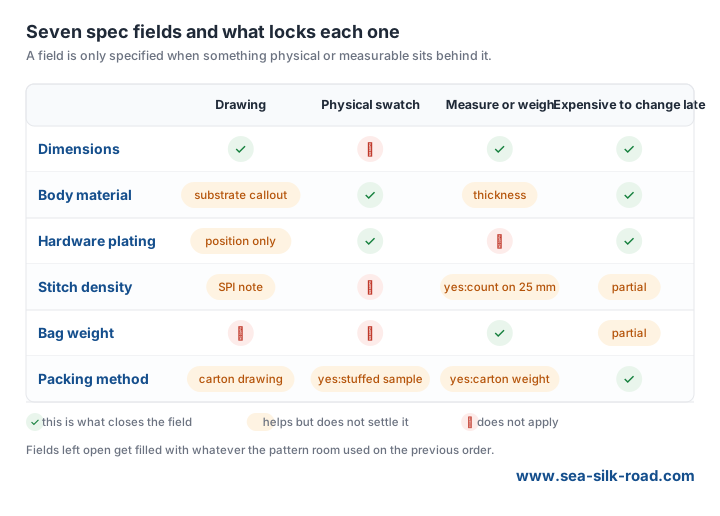
Write the seven fields as a single table, attach a dimension drawing, two material swatches, one hardware swatch and one edge close-up, and make that page the annex to the purchase order. Every field then has evidence behind it, and a bulk inspection becomes a checklist rather than a judgement call. Send the shape you have in mind and the market it sells into, and we will come back with a draft spec sheet for that construction, field by field, before sampling starts.
Planning a promotional gift order?
Send your spec and target quantity for a quote and a digital proof.
Get a free quote


