Handbag Carton Drop Test: 3 Heights and What They Prove
A drop test is not a pass or fail stamp on a carton. It is a way to find out which part of the bag breaks first, at what height, and whether the carton you paid for protects the part the buyer will look at. Three heights answer three different questions, and most suppliers only run one of them.
What a Drop Test Actually Measures
The carton gets stacked, tipped off a trolley, thrown into a van, and pulled out by a courier holding one corner. Each event is a different impact direction at a different energy. A drop test reproduces the energy in a controlled order, so damage shows up in the sample room instead of the shop.
Two numbers define every drop: the height the carton falls from, and the orientation it lands in. Height sets the impact energy, and orientation decides which panel, edge or corner takes it. A carton that lands flat on a face spreads the load over the largest area. The same carton landing on a corner puts the whole energy into a few square centimetres, which is why corner drops find problems that face drops hide.
Test the retail carton the buyer opens, not the export master carton. A master carton of ten bags dropped from 90 cm mostly tests the divider board, and the bag inside can still arrive with a bent handle.
The Three Heights and What Each One Answers
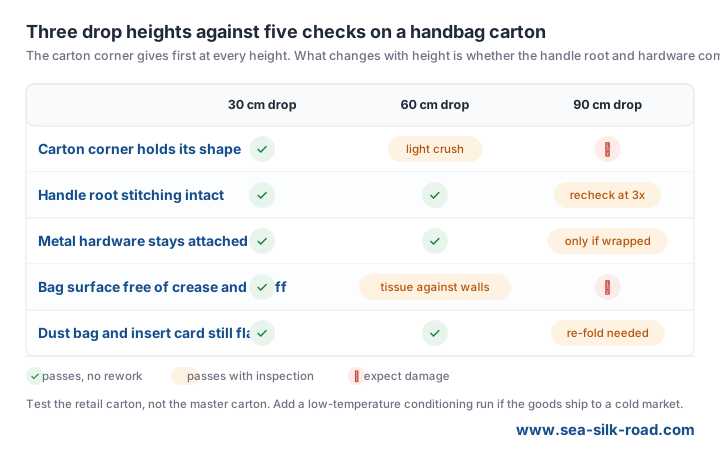
30 cm — the hand-to-floor drop. This is the height a bag falls when someone lifts it off a counter and it slips. Energy is low, so the bag body will survive almost anything. What this height tests is whether small parts stay put: the chain end that was clipped on, the detachable strap hook, the loose hardware in the pocket. If a clasp opens at 30 cm, it will open in a customer hand.
60 cm — the shelf and chute drop. This is the working height of a parcel sorting chute and a van shelf. It is the height where the carton corner starts to crush, and where the internal cushioning either does its job or does not. At this height you check whether the bag inside kept its shape after the corner of the carton folded inward.
90 cm — the over-shoulder and pallet-edge drop. A carton knocked off a stacked pallet or swung off a shoulder arrives here. Energy is roughly nine times the 30 cm case for the same mass, so this is where handle roots, stitching at the strap anchor, and the carton corner board either hold or give.
Run the three in ascending order on separate cartons from the same lot. Reusing one carton carries the damage from the previous height into the next and makes the result unreadable.
Where the Bag Fails First: Handle Roots, Corners, Hardware
In a handbag, the failure order is fairly stable. The carton corner crushes first, because corrugated board has the least resistance to a point load. The handle root goes next, at the stitch line where the strap meets the bag body, because that is where the impact load concentrates when the bag shifts inside the carton. Metal hardware detaches third, and usually only if it was packed loose and acted as a hammer against the bag body on the way down.
The bag body itself rarely fails. PU and split leather deform and recover. What does not recover is a crease in the grain at a fold line, and a scuff on a corner that has been pressed against the carton wall. Both are cosmetic rejects at the buyer end, and both are cheap to prevent with a sheet of tissue between the bag and the carton wall.

Setting the Cushioning for a Handbag Carton
Three cushioning choices cover most handbag cartons, and they fail in different ways. A die-cut corrugated insert with a cavity holds the bag in one position and stops it sliding, but it transmits point loads straight into the bag at the cavity edges. EPE foam wraps absorb energy and are forgiving of shape, but they add volume and cost, and thin sheets compress to nothing after one hit. Molded pulp sits between the two: it holds shape, absorbs reasonably, and packs flat before use.
Practical combinations that survive 60 cm without rework: a die-cut insert plus 10 mm EPE on the two faces that touch the carton, or a molded pulp cradle plus a tissue wrap on the hardware. Do not wrap the handle in foam and leave the body free. The handle then becomes the rigid point that the bag swings from, and the stitch line takes the whole load.
If the goods ship to a cold market, condition three cartons at low temperature before the drop. PU stiffens as it cools, and a cold panel cracks at a fold that would flex at room temperature.
Reading the Result: Pass, Fail, and the Grey Zone
Write the pass criteria before the test, not after. A workable list: carton corner may deform but must not open; handle root stitching must stay intact with no pulled threads; every piece of hardware still attached; no crack in the grain at a fold; no scuff that needs touch-up; dust bag and insert card still flat enough to hand over.
The grey zone is cosmetic damage that a buyer would notice but a factory would call normal. Decide in advance which of those get reworked and which get scrapped, and photograph the boundary case. A photo of an acceptable corner crush settles the argument at the loading dock faster than any wording.
Write It Into the Spec Sheet
Put four lines in the purchase order: the carton dimensions and board grade, the three drop heights with orientation order, the cushioning materials with thickness, and the pass criteria with the boundary photo attached. Then require the test report per production lot, with carton weight recorded — impact energy scales with mass.
If you are sourcing handbags and want the carton decided at the same time as the bag, send the bag dimensions, the target unit weight and the shipping mode, and we will quote the carton, insert and drop-test report as one line item.
Planning a promotional gift order?
Send your spec and target quantity for a quote and a digital proof.
Get a free quote


