Handbag Inspection AQL: 2.5 vs 4.0 for Sewn Goods
AQL 2.5 and AQL 4.0 do not describe how good a handbag factory is. They describe how many defective pieces you agree to accept in a sample, which is a different thing. On a 3,000 piece order the gap between the two levels is the difference between rejecting a lot at 8 defective bags in a 125 piece sample and rejecting it at 11. That is the whole decision, and it is worth settling before the inspection day.
What AQL actually decides
AQL stands for acceptance quality limit and sits inside ISO 2859-1, the standard sampling scheme most Chinese bag factories and third party inspection firms work to. You pick three things: the lot size, the inspection level, and the AQL value for each defect class. The lot size plus the level gives a sample size. The sample size plus the AQL gives two numbers, Ac and Re, the acceptance and rejection counts. Inspect the sample, count defects, compare with Ac. Nothing in that chain measures the factory process; it measures one shipment.
Almost every disagreement about inspection traces back to someone treating AQL as a defect rate. It is not. An AQL of 2.5 does not mean 2.5 percent of the order may be defective. It means a lot is accepted if the sample falls at or below the acceptance number, which is set so that lots at that quality level are accepted most of the time. Small lots and large lots get different sample sizes for the same AQL, so comparing acceptance numbers between two orders tells you nothing.
The numbers at three lot sizes
General inspection level II is the default for consumer goods and the level to insist on unless there is a reason otherwise. Under single sampling, normal inspection, the acceptance numbers look like this. A lot of 501 to 1,200 pieces draws a sample of 80: AQL 2.5 accepts at 5 defects and rejects at 6, while AQL 4.0 accepts at 7 and rejects at 8. A lot of 1,201 to 3,200 draws 125: AQL 2.5 accepts at 7 and rejects at 8, AQL 4.0 accepts at 10 and rejects at 11. Above that, 3,201 to 10,000 draws 200, where the acceptance numbers move up again.
A tight AQL does less work than buyers expect on small orders. On a 150 piece trial run the sample is 20 pieces whatever level you choose, and AQL 2.5 accepts the lot with a single defect in it. If a trial order of that size has to be clean, sampling is the wrong tool and a full check of every piece is the right one.
Where 2.5 earns its cost on a handbag
Sewn goods fail visibly. A skipped stitch on the front panel, a wavy topstitch across a flap, a raw edge showing at the gusset: each one is a return from a retail customer who sees it in the first ten seconds. That is what AQL 2.5 is for.

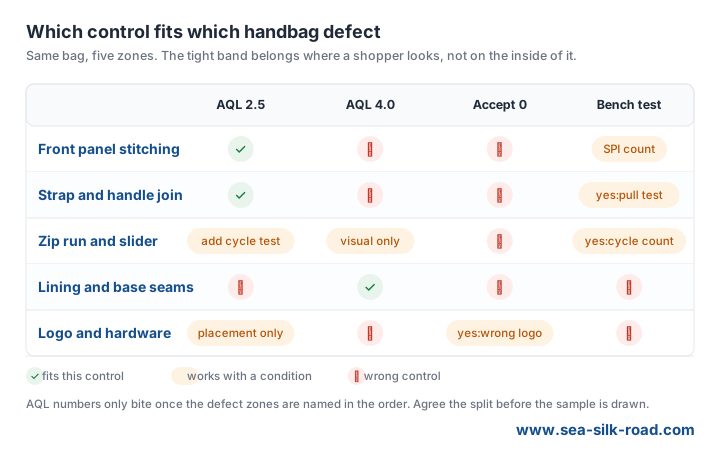
Three defect families justify the tighter band. Stitch density and skipped stitches, because both are countable and both are obvious. Strap and handle attachment, because a bag that fails there fails in use, not in the shop. And edge paint or burnishing gaps, because a soft edge that lifts in the first month is a complaint that arrives long after the inspection report was signed. AQL 2.5 on these three, with the sample judged on the finished piece rather than on a cut panel, catches most of what reaches a customer.
Where 4.0 is the honest choice
AQL 4.0 is not a discount tier for factories that cannot hit 2.5. It is the right level for defects the end user will never see or will not mind: lining seams inside the main compartment, the base panel on a bag carried with the bottom away from the eye, small shade differences on an internal pocket. Applying 2.5 to those zones produces rejections that cost the factory money for something no customer notices, and factories recover that cost by quoting higher on the next order.
Critical defects are separate and sit at acceptance zero. A child safety issue, a sharp hardware edge, a wrong logo, a strap attached with the hardware reversed: one occurrence rejects the lot, and inspection should check for those on every piece in the sample rather than counting them. Write the acceptance zero in the purchase order, because a factory that has only ever seen 2.5 and 4.0 will otherwise ask which number applies.
Writing the defect classes into the purchase order
An AQL number on its own is unenforceable, because two inspectors will classify the same wavy seam differently. The order needs a short defect list with the zones named. A workable version for a sewn bag has four lines. Critical: safety, branding, hardware orientation, acceptance zero. Major A: stitching, topstitch alignment, edge finish and hardware marks on the front, flap, gusset and handle, at AQL 2.5. Major B: the same families on the back panel, base and internal pockets, at AQL 4.0. Minor: shade variation, dust, packing marks, at AQL 4.0 with a note that they are recorded but not counted against the lot.
Name the inspection level too, General II unless the order justifies General III, and name the sampling scheme, single or double. Double sampling is worth considering on mid-size orders: it can accept a good lot on a smaller first sample and only expand when the count sits in the grey zone, which shortens inspection time without loosening the standard.
Running the inspection day
Three things decide whether the report is usable. The sample has to be drawn from finished, packed goods rather than from the line, otherwise you are inspecting work in progress. The measurement tools have to be on the table: a stitch density gauge or a ruler and a marked 25 mm window, a colour card for the thread, a tape measure for the stated dimensions. And the report has to photograph every defect with the piece number, because a rejection argued from a description is a rejection that gets negotiated away.
Finally, agree what happens on a fail before the inspection, not after. The usual options are a second sample from the same lot, a rework and re-inspection at the factory cost, or shipment with a price adjustment. Putting that in the order turns an AQL number into a procedure.
Send the defect zones, the inspection level and the target AQL you are working to, and we will confirm how the sample will be drawn and photographed before your inspection day is booked.
Planning a promotional gift order?
Send your spec and target quantity for a quote and a digital proof.
Get a free quote


