School Backpack Load Test: 5 Checks Before a September Shipment
Five checks decide whether a school backpack survives a full term or comes back as a complaint in week six, and four of them can be done in an hour with a hook, a spring scale and a tape measure. None require a lab. What they require is a number written on a sheet before the cartons are sealed, because each of these failures is cheap to fix in the sample room and expensive after the container sails.
The sequence is ordered by what it costs to discover the problem late, and it holds for orders of 500 to 5,000 pieces per style on both a 16-litre primary bag and a 30-litre secondary one with a laptop sleeve.
Start with the 8 kg hang, measured after 24 hours
Eight kilograms is a fair working load: a laptop, two textbooks, a water bottle and a lunch box land close to it on a normal Tuesday. Mark the distance from the top edge of the back panel to the centre of the base seam, hang the bag from both shoulder straps on a single hook so the base carries nothing, leave it 24 hours, then measure again.
A body that returns to within 3 mm is holding its shape. One that has grown 10 mm or more has either a stitch run too sparse at the strap anchor or webbing stretching under load, and both keep growing every term. The number matters more than the verdict: 12 mm on a sample tells you to change the anchor before cutting starts, while the same reading on a bulk carton tells you what to negotiate.
The four seams that fail first
Load concentrates at four points: the strap-to-body anchor at the top, the two base corners, the zipper end where the gusset meets the body, and the handle patch. Ask for a box-X stitch at the anchor with a bar tack across the webbing end, and count the run: 7 to 8 stitches per 25 mm on bonded nylon thread, ticket 20/3 or heavier, is a working density. Six per 25 mm with a light thread looks identical in a photo and opens under the same 8 kg.
Pull the seam rather than looking at it. A spring scale hooked into the seam allowance and pulled to 150 N across 50 mm shows whether the stitch line grips the weave or slides between yarns. On a coated fabric the needle holes should close when load comes off; if they stay open, the coating is thin and water will find them.

The laptop sleeve deserves its own line on the sheet. It is stitched to the back panel and carries the device through a seam that is not part of the main body, so it needs the same density and a bar tack at both bottom corners. On a school backpack with a 15-inch sleeve, those corners take roughly a third of total load when the bag is worn on one shoulder.
Webbing, buckles, and the strap drop buyers forget
Measure webbing width first: 25 mm is the minimum for a loaded secondary bag, 30 mm is better on a 30-litre body. Polypropylene is light and cheap and creeps; polyester creeps less for a little more money. Either works if the adjuster is sized for it, and neither works if the webbing is 1 mm thinner than the adjuster slot.
Prove the slip with evidence. Load the bag to 10 kg, lift by one strap, hold ten seconds, mark the webbing at the adjuster with a pen, and repeat twenty times. More than 5 mm of creep means the adjuster is the wrong size for the tape, not that the user pulled too hard.
Then measure strap drop, top of the shoulder strap to top of the body, on a person rather than a mannequin. For primary-age users 45 to 55 cm covers most builds at 16 to 22 litres; a 60 cm drop on a 20-litre bag puts the base below the hips and the load on the lower back, which no seam repair will fix.
Zipper: judge the tape and the stitch, not the slider brand
A #5 nylon coil suits a main compartment up to about 25 litres, #8 for anything larger. What matters more than size is attachment: 6 stitches per 25 mm or denser, the tape end folded and stitched rather than glued, and a tape of uniform width. A glued tape end is the most common cause of a zip that splits at the corner three months in.
Test it loaded. Fill the bag to working load, open the main zip halfway, and pull the slider at roughly 45 degrees, the way a hand pulls on a full bag. Thirty pulls on the same slider will show separation behind it and any pull tab working loose. On a two-way zip, both sliders should meet without a gap and neither should pass the other under load.
Back panel: compression set beats quoted thickness
Most quotes state foam thickness, which says little about week ten. Compression set does: press a thumb into the panel, hold ten seconds, release, and time the recovery. Foam that stays dented more than three or four seconds flattens under books, and the wearer ends up feeling the zip ends through the panel.
8 to 10 mm of EVA or cross-linked PE under a knit mesh is sound for a school bag, provided the panel is stitched around its perimeter rather than only glued, and the mesh lets air move. Glue-only panels delaminate at the top edge first, which is where a buyer runs a finger on arrival.
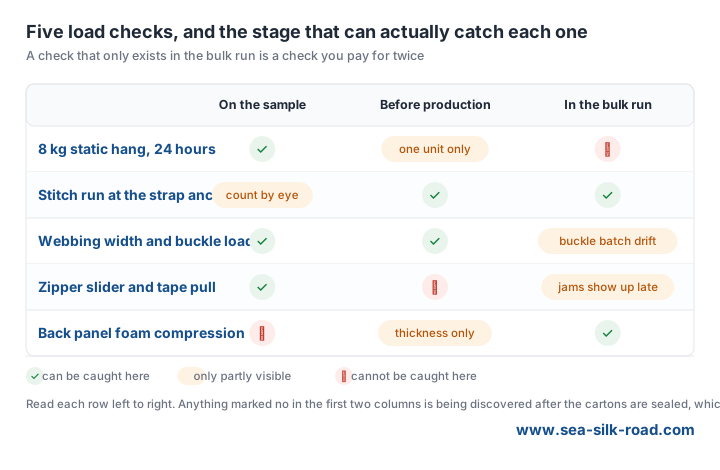
Put the five checks on one page of the order
The checks only work if they leave the sample room. Give each row a method, a sample size, a pass line and a person: 8 kg hang for 24 hours on three pieces per colour, passing at 3 mm measured stretch; seam density at the anchor from a cut scrap per production line; webbing creep under 5 mm after twenty lifts; thirty loaded zip pulls with no separation; thumb compression recovery under four seconds. Five rows, one page, signed before the first carton.
Bulk inspection then becomes arithmetic instead of opinion. Pull five pieces per colour per carton, repeat the destructive checks on one, and compare numbers to the sheet rather than to memory. When a row fails, the sheet shows which stage should have caught it, which is the difference between a fixable conversation and a container nobody wants to open.
Planning a promotional gift order?
Send your spec and target quantity for a quote and a digital proof.
Get a free quote


